

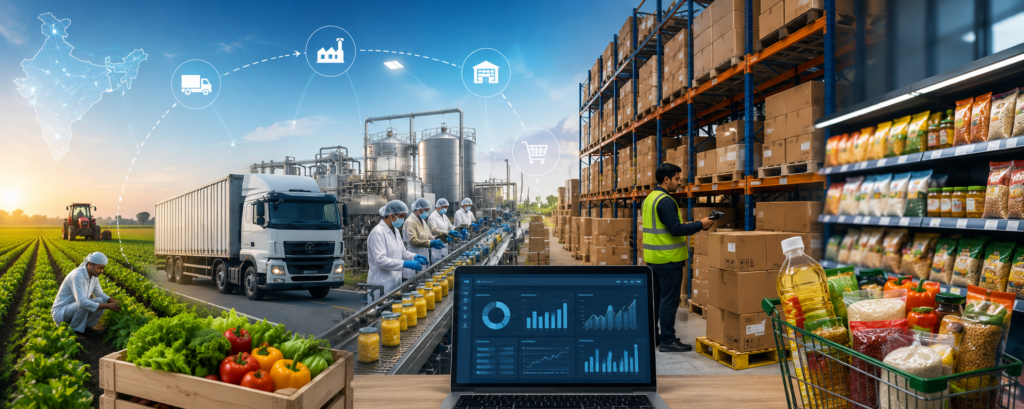
If you run a food distribution, wholesale, or manufacturing business in India, you already know how complicated it is to keep everything moving smoothly. From managing supplier orders to tracking stock across multiple warehouses — the challenges are real, and they are costly. That is exactly where food supply chain software comes in.
In this complete guide, we will explain what food supply chain software actually is, what it does, who needs it, and why more food businesses in India are switching from manual processes to digital platforms in 2024.
What is Food Supply Chain Software?
Food supply chain software is a digital platform that connects and manages all the key operations involved in getting food products from the supplier to the end buyer — including procurement, inventory tracking, order management, warehouse operations, logistics coordination, and payments.
Instead of relying on phone calls, Excel sheets, or WhatsApp groups to manage your supply chain, this software gives you a single centralised system where every party — suppliers, distributors, warehouse teams, and buyers — can operate in sync.
Think of it as the digital backbone of your food business.
Why Does the Food Industry Need Specialised Supply Chain Software?
Food is not like any other product category. It has unique challenges that generic ERP or inventory tools simply cannot handle well:
- Expiry dates and batch tracking: Every item has a shelf life. Without proper tracking, expired stock reaches buyers — causing returns, losses, and reputation damage.
- Spoilage and wastage: Temperature sensitivity, improper storage, and delayed delivery all lead to spoilage. Real-time visibility helps reduce this significantly.
- Complex multi-party distribution: Food moves through multiple hands — manufacturer to primary distributor to secondary distributor to retailer. Each link needs to be connected.
- Demand volatility: Festivals, harvest seasons, and regional demand spikes make forecasting difficult without data.
- Regulatory compliance: Food businesses must maintain quality records, FSSAI compliance documentation, and traceability data.
A purpose-built food supply chain software addresses all of these challenges within one platform — rather than patching together multiple tools.
Key Features of Food Supply Chain Software
Here are the core features you should expect from a good food supply chain platform:
1. Inventory and Warehouse Management
Track stock levels in real time across one or multiple warehouses. Monitor batch numbers, expiry dates, and FIFO/FEFO inventory rotation to minimise spoilage. Get alerts when stock falls below reorder levels so you never face stockouts during peak demand.
2. Order Management
Manage purchase orders from suppliers and sales orders from buyers on one screen. Track order status from placement to delivery, reduce manual errors, and ensure buyers always receive accurate updates on their shipments.
3. Supplier and Vendor Management
Maintain a supplier directory with performance records, pricing history, and reliability scores. Knowing which suppliers consistently deliver on time — and which do not — helps you make better procurement decisions.
4. Demand Forecasting
Use historical sales data and seasonal patterns to predict how much stock you will need weeks in advance. Good demand forecasting in food distribution can reduce over-purchasing by 20 to 30 percent.
5. Supply Chain Visibility
Get a real-time view of where your goods are at every stage — from supplier dispatch to warehouse receipt to buyer delivery. Supply chain visibility is no longer a luxury for large enterprises; even mid-sized distributors in India need it to stay competitive.
6. Payments and Credit Tracking
Track outstanding payments, credit limits for buyers, and payment terms with suppliers. Many food distributors in India still manage this manually, which leads to bad debt and cash flow problems.
Who Needs Food Supply Chain Software?
This type of software is most useful for:
- Food distributors and wholesalers managing large volumes of perishable goods
- FMCG distributors supplying retail chains or kirana stores across regions
- Food manufacturers managing raw material procurement and finished goods distribution
- Cold chain logistics providers handling temperature-sensitive products
- Agri-businesses managing procurement from farmers and distribution to processors or retailers
If your business falls into any of these categories and you are still managing operations on spreadsheets or phone calls, you are likely losing time and money every single day.
How Food Supply Chain Software Helps Indian Food Businesses Specifically
India’s food distribution landscape is highly fragmented. Most businesses still operate with a combination of phone orders, paper records, and manual stock counts. As a result, stock mismatch, delayed deliveries, and payment disputes are extremely common.
A food supply chain platform built for India addresses specific local challenges:
- Multi-state and multi-warehouse operations common among regional distributors
- Managing supplier reliability in states like Punjab, Haryana, Maharashtra, and UP where supply chains are complex
- Handling seasonal procurement spikes during harvest seasons
- Credit management for small and medium buyers who operate on deferred payment terms
- Generating compliance documentation for FSSAI and state food authority requirements
What to Look for When Choosing Food Supply Chain Software
Not all supply chain platforms are built for the food industry. When evaluating options, look for:
- Industry-specific features: Expiry tracking, FIFO/FEFO support, batch management — these are non-negotiable for food businesses.
- End-to-end visibility: The platform should connect suppliers, warehouse, logistics, and buyers in one view.
- Ease of adoption: Your warehouse team and distributors should be able to use it without weeks of training.
- Scalability: As your business grows from one region to multiple states, the software should scale with you.
- Local support: For Indian businesses, having support in your time zone and language makes a real difference.
Conclusion
Food supply chain software is no longer something only large enterprises can afford or use. Today, platforms like FoodBridge are making end-to-end supply chain management accessible for mid-sized distributors, wholesalers, and manufacturers across India.
If you are managing food distribution operations manually today, the real question is not whether you need this software — it is how much longer you can afford not to have it.
🔗 CTA: “See how FoodBridge manages your food supply chain →”

One Response