
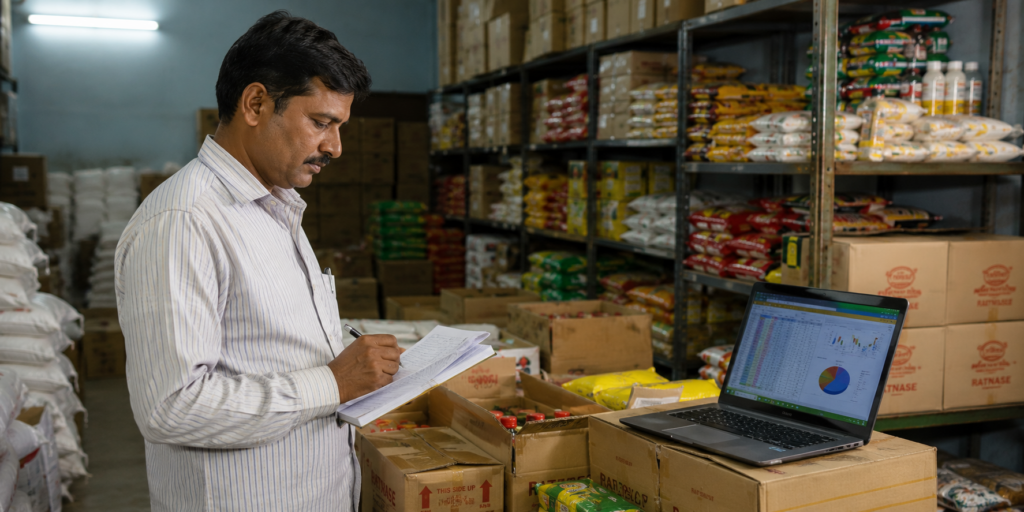
Walk into any wholesale market in Ludhiana, Amritsar, or Karnal on a busy morning, and you will see the same story playing out. Trucks are lined up outside, buyers are calling on the phone, and warehouse staff are rushing between shelves trying to confirm whether a particular item is actually in stock. Somewhere in the middle of all this movement, a distributor is staring at a spreadsheet that was last updated two days ago — and hoping the numbers are still correct.
This is what inventory management for food distributors looks like in most businesses across Punjab and Haryana today. Not because these distributors are not hardworking or not capable — but because managing food inventory is genuinely one of the hardest operational challenges in any business. Food expires. Demand changes overnight. Suppliers deliver late. And somehow, the distributor has to keep everything moving without losing stock, money, or customer trust.
In this guide, we will walk through exactly how food distributors can manage inventory better — explained in simple, practical terms that anyone running a distribution business can understand and apply, whether you are handling dairy products in Hisar, FMCG goods in Jalandhar, or packaged foods in Rohtak.
Why Inventory Management is So Difficult for Food Distributors
Before we talk about solutions, it helps to understand why this problem exists in the first place. Most industries deal with products that sit on a shelf for months or even years. A hardware distributor does not worry about his bolts expiring. A furniture wholesaler does not lose sleep over his stock going bad overnight. But food is completely different.
Every item in a food warehouse has a shelf life. Milk lasts a few days. Packaged snacks last a few months. Pulses and grains can last longer — but even they require proper storage conditions to stay sellable. The moment an item crosses its expiry date, it cannot be sold. It becomes a direct loss for the distributor.
On top of that, demand in Punjab and Haryana is heavily influenced by festivals, harvest seasons, and regional food habits. During Diwali or Lohri, demand for certain products can double or triple overnight. During the wheat harvest season in April and May, procurement patterns shift completely. A distributor who does not track these patterns closely will either overstock — locking up cash in slow-moving goods — or understock and lose orders to a competitor.
And then there is the human factor. Most distributors in this region still rely on a combination of phone calls, paper registers, and Excel sheets. Each of these tools works fine on its own — but when they are not connected to each other, gaps appear. A sale gets recorded on paper but not in the system. A delivery gets dispatched but the stock count is not updated immediately. A new batch arrives from the supplier but gets stored on top of older stock. These small mistakes, repeated over weeks and months, add up to serious losses.
The Basics of Good Inventory Management — Explained Simply
Good inventory management, at its core, is about knowing three things at all times: what you have, where it is, and how long it will last. Everything else — systems, software, processes — exists to help you answer these three questions accurately and quickly.
The first principle that every food distributor must understand is FIFO — First In, First Out. This simply means that the stock which arrived in your warehouse first should be the stock that leaves first. If you received a batch of biscuits on Monday and another batch on Friday, the Monday batch should be picked and dispatched before the Friday batch. This sounds obvious, but in a busy warehouse with dozens of products and multiple batches, it is extremely easy to accidentally dispatch newer stock while older stock sits at the back of the shelf slowly approaching its expiry date.
For perishable goods like dairy, meat, or fresh produce, distributors often follow FEFO — First Expired, First Out. This means instead of going strictly by arrival date, you dispatch the item whose expiry date is nearest first. In practical terms, this means your warehouse team must always know which batch expires when — and this is simply not possible to track reliably with a paper register when you are handling thousands of units across multiple product categories.
The second principle is reorder point management. Every product in your warehouse should have a minimum stock level — a number below which you should never let your stock fall. When your stock of any item reaches that level, it is time to place a new purchase order with the supplier. Without this discipline, distributors frequently find themselves running out of fast-moving goods during peak demand periods, which means turning away buyers and losing revenue that is very hard to recover.
The Real Cost of Poor Inventory Management in Punjab and Haryana
Let us talk in concrete terms. Imagine a mid-sized FMCG distributor based in Patiala, supplying around 200 retailers across the district. Every month, even if just 2 percent of his total stock goes to waste due to expiry or damage, that translates to a direct loss on the cost of those goods plus the storage and handling cost already spent on them. For a business doing one crore rupees of monthly turnover, that is two lakh rupees disappearing every single month — not because the market is bad, but simply because inventory was not managed well.
Beyond the financial loss, there is the cost to relationships. In Punjab and Haryana, business runs on trust. A retailer in Bathinda who places an order with you and receives the wrong product, or a partially fulfilled order, or — worst of all — a product that is near its expiry date, will not just complain once. He will start looking for another distributor. And in a region where word of mouth travels fast through community networks and WhatsApp groups, one bad experience can affect multiple relationships at the same time.
How Digital Inventory Management Changes the Game
This is where modern inventory management software specifically built for food distribution makes a transformational difference. The key word here is specifically — because a generic accounting software or a basic ERP system is not the same as a platform designed to handle the real-world complexity of food distribution.
A proper food distribution platform tracks every batch of every product from the moment it arrives in your warehouse to the moment it leaves. It records the manufacturing date, the expiry date, and the quantity. When your warehouse team picks stock for an order, the system automatically suggests which batch to pick based on FIFO or FEFO rules — removing the guesswork and the risk of human error entirely.
Beyond batch tracking, these platforms give you real-time stock visibility. This means that at any moment — whether you are sitting in your office in Chandigarh or travelling to meet a supplier in Delhi — you can open an app or a dashboard and see exactly how much of each product you have, which batches are approaching expiry, which products are running low, and which items have not moved in weeks.
For distributors managing multiple warehouses across different districts of Punjab or Haryana, this visibility is not just convenient — it is essential. Without it, you are essentially running a business blind, making decisions based on incomplete information and hoping the numbers work out at the end of the month.
Managing Supplier Relationships and Procurement Better
Inventory management does not start in the warehouse. It starts at the point of procurement — the moment you place an order with a supplier. If your supplier delivers late, delivers a short quantity, or delivers products with a shorter shelf life than agreed, your entire inventory plan for that week gets disrupted.
This is why tracking supplier performance is just as important as tracking your own stock. Good food distributors maintain a record of how reliable each supplier is — how often they deliver on time, how often their quantities match the purchase order, and how consistent their product quality is. Over time, this data helps you make smarter procurement decisions: ordering more from reliable suppliers, keeping backup suppliers for critical products, and building stronger negotiating positions when it comes to pricing and payment terms.
In Punjab specifically, where many distributors source directly from farmers and local manufacturers during harvest season, this kind of structured procurement tracking can make the difference between a profitable quarter and a chaotic one.
Practical Steps to Improve Inventory Management Starting Today
If you are a food distributor in Punjab or Haryana and you want to improve your inventory management, the first step is to conduct an honest stock audit. Go through your warehouse and identify which products have less than 30 days to expiry. Identify which products have not moved in more than 60 days. Identify which products consistently run out before your next procurement cycle. This audit will immediately show you where your biggest losses and risks are.
The second step is to standardise how your warehouse team handles incoming stock. Every batch that arrives should be labelled with its arrival date and expiry date before it is put on the shelf. Older stock should always be placed at the front, newer stock at the back. This one simple discipline, consistently followed, can dramatically reduce expiry losses.
The third and most impactful step is to move away from manual tracking and adopt a digital platform built specifically for food distribution. The investment is far smaller than most distributors expect, and the returns — in terms of reduced wastage, fewer stockouts, better supplier management, and cleaner financial records — typically show up within the first two to three months of use.
Conclusion
Inventory management for food distributors is not just an operational task — it is the foundation on which your entire business sits. Get it right, and you reduce losses, serve customers better, and build a business that can scale. Get it wrong, and no amount of hard work or good relationships will protect you from the slow drain of expired stock, missed orders, and wasted procurement spending.
Distributors across Punjab and Haryana are already making this shift — from manual processes to digital platforms that give them real visibility and real control over their inventory. The question is not whether this change is coming. The question is whether you will be ahead of it or behind it.
🔗 CTA: “See how FoodBridge helps food distributors manage inventory in real time →”