
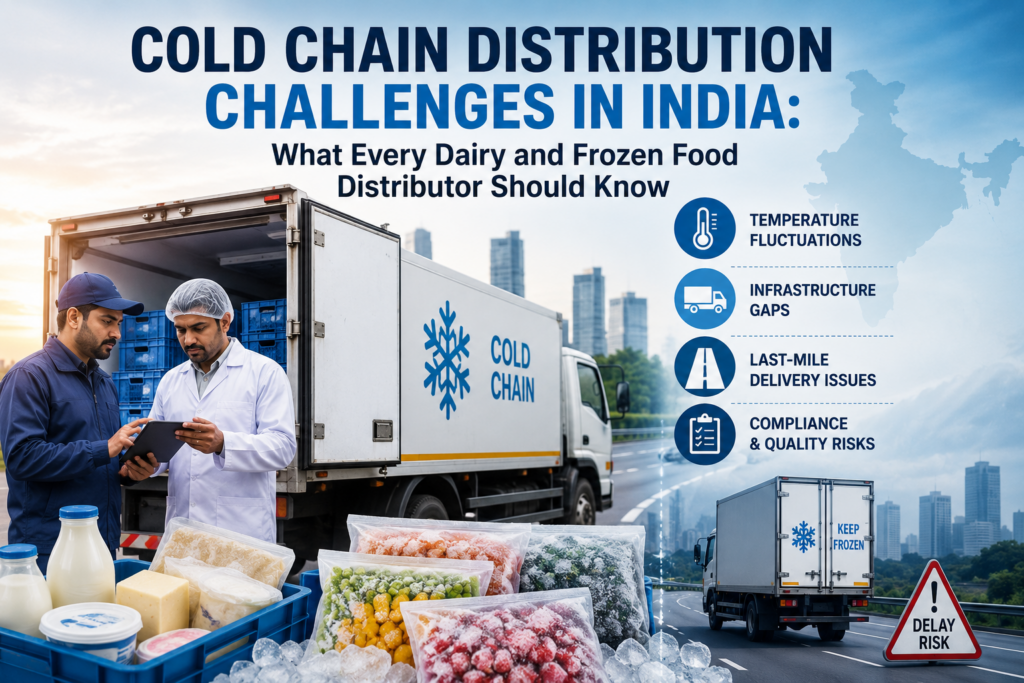
It was a Tuesday afternoon in May when Manpreet, a dairy distributor based just outside Ludhiana, got the call he had been dreading for weeks. A retailer in Khanna had opened a fresh delivery of paneer and found it already turning. The batch had left Manpreet’s cold store in perfect condition that morning. Somewhere between his warehouse and the retailer’s shop, something had gone wrong — and he had no way of knowing exactly where, or why. This is the quiet, recurring nightmare behind cold chain distribution challenges that dairy and frozen food distributors across Punjab and Haryana live with every single day, often without the tools to ever find the real answer.
Manpreet’s story is not unusual. Talk to almost any dairy or frozen food distributor across this belt of Punjab and Haryana — from Patiala to Hisar, from Jalandhar to Karnal — and you will hear some version of the same story. A product leaves the cold store perfectly fine. It arrives somewhere down the line compromised. And nobody can say with confidence exactly where the chain broke.
Why Punjab and Haryana Make Cold Chain Distribution Especially Hard
To understand why Manpreet’s paneer turned bad somewhere on a forty-minute drive, you first have to understand the conditions his cold chain operates under. Summers in this region routinely cross 45 degrees Celsius. A refrigerated van that loses cooling power for even fifteen minutes during loading, or sits stationary in direct sun while a delivery boy finishes another drop, can see internal temperatures climb fast enough to start degrading dairy products well before anyone notices a problem.
Then there is the electricity question. Across smaller towns and semi-urban distribution points throughout this belt, power cuts are still a fact of daily business life. A cold storage unit running on grid power alone, without reliable backup, can experience hours of compromised cold chain integrity during a single bad week — and many distributors only discover the damage after the fact, when a retailer calls to complain, exactly as happened to Manpreet.
And then there is the sheer geography of distribution in this region. Dairy and frozen products often move from a central processing point through one or two intermediate cold storage stops before finally reaching a retailer. Every single one of these handover points — truck to warehouse, warehouse to delivery van, van to retailer’s display fridge — is a moment where temperature control can quietly slip, even for just a few minutes, even when everyone involved believes they are doing everything correctly.
The Investigation That Never Quite Finds an Answer
After the call from Khanna, Manpreet did what most distributors in his position do. He called his driver, who insisted the cooling unit in the van was working fine the entire route. He checked with his warehouse staff, who confirmed the paneer had left the cold store at the correct temperature. He had no real way to verify either claim, because nothing along that journey had actually been measured and recorded. The only evidence he had was a single, secondhand phone call describing paneer that had already gone bad by the time anyone noticed.
This is perhaps the most frustrating part of cold chain distribution challenges as they actually play out for distributors in Punjab and Haryana. It is rarely one dramatic failure that causes the loss. It is usually a small, undetected lapse — a few minutes here, a slightly delayed handover there — that compounds invisibly until a product fails far downstream, by which point there is no way to trace it back to its actual cause. Without that traceability, the same failure simply repeats itself the following week, and the week after that.
What Changes When You Can Actually See the Chain
A few months after the Khanna incident, Manpreet made a change that many dairy distributors in the region are now starting to consider. Instead of relying on phone calls and assumptions, he began tracking his cold chain digitally, with batch-level visibility into when each shipment left the cold store, what condition it was recorded in, and where it moved at each stage along the way to the retailer.
The change was not about adding complexity to his operation. It was about finally being able to answer the question that had haunted him after that call from Khanna: where, exactly, did this go wrong. With proper supply chain visibility in place, the next time a retailer raised a concern, Manpreet could actually trace the batch back through each handover point and identify precisely where a delay or temperature lapse had occurred, rather than relying on guesswork and phone calls that rarely told the full story.
This shift also changed how he managed his cold storage rotation. Rather than rotating stock based on rough memory of what arrived when, his team began following strict expiry-based stock rotation, ensuring that the dairy products closest to their effective shelf life, particularly important given how temperature variations can quietly shorten that shelf life, were always moved first.
Building Resilience Into a Difficult Climate
Visibility alone does not solve every cold chain problem in a region as hot and infrastructure-constrained as Punjab and Haryana. Manpreet also invested in backup power for his main cold storage unit, a decision that paid for itself within the first major summer power outage, when his stock stayed protected while a competitor down the road lost an entire day’s dairy inventory to a six-hour outage with no backup in place.
He also retrained his delivery staff specifically around handover discipline, emphasising that even a few minutes of a van sitting unrefrigerated during a delivery stop can meaningfully shorten a dairy product’s remaining shelf life. Small procedural changes, reinforced consistently, made a measurable difference in how often products arrived at retailers in the condition they were meant to.
What This Means for Other Distributors Across the Region
Manpreet’s experience is not unique, and that is exactly the point. Across Punjab and Haryana, dairy and frozen food distributors are operating cold chains stretched thin by extreme heat, inconsistent power, and multi-stage distribution networks, often without the visibility needed to catch problems before they become losses. The distributors who are starting to get ahead of these cold chain distribution challenges are not necessarily the ones with the biggest operations. They are the ones who have stopped relying on assumptions and started building real, traceable visibility into how their products actually move from cold store to customer.
Conclusion
Every dairy and frozen food distributor in Punjab and Haryana has their own version of Manpreet’s phone call from Khanna. The question is whether that call leads to another shrug and an unanswerable mystery, or whether it becomes the moment a distributor finally builds the visibility needed to find real answers, and prevent the same loss from happening again next month.
🔗 See how FoodBridge brings full visibility to your cold chain →
Frequently Asked Questions
What are the biggest cold chain distribution challenges in Punjab and Haryana?
Extreme summer temperatures, inconsistent electricity supply affecting cold storage, and multiple handover points between processing, storage, and retail delivery are the most significant cold chain challenges distributors face in this region.
How can distributors track where a cold chain failure actually happened?
Digital supply chain visibility tools that record batch status, temperature, and location at each handover point allow distributors to trace exactly where a delay or temperature lapse occurred, rather than relying on phone calls and guesswork.
Why do dairy products specifically suffer more from cold chain failures?
Dairy products have a naturally short shelf life that is highly sensitive to even brief temperature fluctuations. A few minutes outside proper refrigeration can meaningfully shorten the remaining usable shelf life of products like paneer and milk.
Does backup power really make a difference for cold storage in this region?
Yes. Given how frequent power interruptions can be in semi-urban parts of Punjab and Haryana, backup power for cold storage units is one of the most cost-effective investments distributors can make to prevent large-scale spoilage events.
How does FoodBridge help with cold chain distribution challenges?
FoodBridge provides batch-level visibility across the supply chain, helping distributors track stock from cold storage through delivery, apply proper expiry-based rotation, and quickly identify where issues occur when they do arise.