
It Started With 50 Extra Packets of Curd
Ramesh runs a dairy distribution business in Nagpur.
One Tuesday morning, three of his biggest retailers called almost at the same time. Each wanted more curd than usual — a local festival was coming up, and demand was picking up fast.
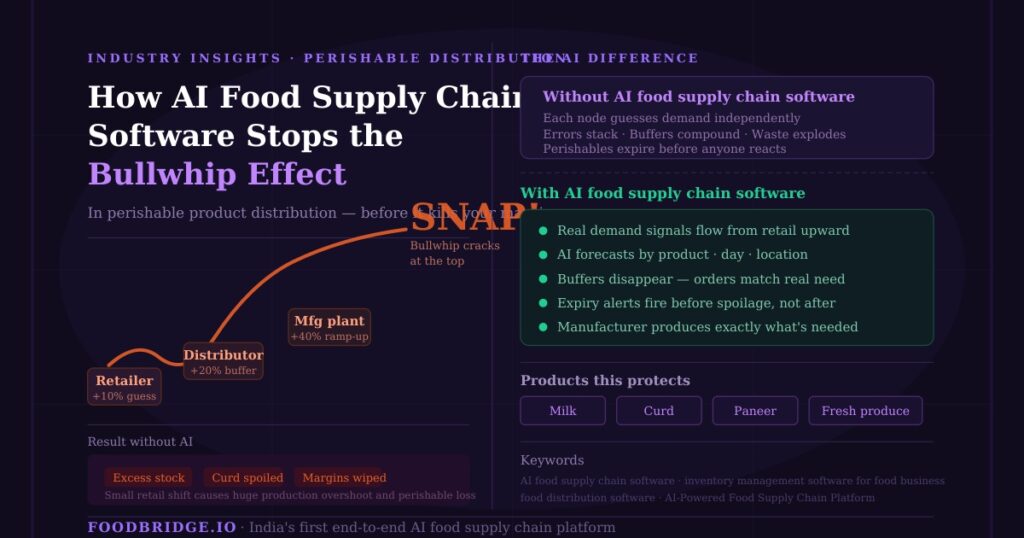
Ramesh did what any sensible distributor would do. He called his manufacturer and placed a bigger order. “Send me 30% extra this week, just to be safe.”
The manufacturer, seeing this sudden spike from Ramesh — and from two other distributors who had done the same thing — assumed demand had genuinely gone up across the board. So they ramped up production by 40%.
By the time the festival weekend arrived, Ramesh had more curd in his cold storage than he could possibly sell. The retailers, who had also over-ordered “just in case,” were not buying. The manufacturer was sitting on excess inventory too.
Result? Hundreds of kilograms of curd went unsold. Spoiled. Thrown away.
The festival came and went. And Ramesh lost money he never had to lose.
What Just Happened? Meet the Bullwhip Effect.
What Ramesh experienced has a name in the supply chain world — it is called the bullwhip effect.
Think of cracking a whip. A small flick of the wrist at one end creates a massive snap at the other end. That is exactly what happens in a food supply chain.
A small change in what a retailer orders — even a 10% bump — travels upstream through the distributor, the manufacturer, and the raw material supplier, getting bigger and more distorted at every step. By the time it reaches the top of the chain, that small flick has turned into a full crack.
For perishable products — milk, curd, paneer, fresh produce, packaged foods with short shelf lives — this effect is not just a textbook problem. It is a daily financial nightmare.
And here is the painful part: AI food supply chain software is the one tool that can stop it. Yet most food businesses in India are still running on Excel sheets and gut feeling, wondering why their margins keep shrinking.
Why Perishables Make It So Much Worse
Every product in every supply chain is vulnerable to the bullwhip effect. But for perishables, the consequences are far more severe — because you cannot wait.
A clothing distributor sitting on excess stock can sell it next month. A stationery supplier can store excess paper for a year if needed.
But a dairy distributor sitting on 500 extra litres of milk? He has maybe 48 hours before the loss becomes permanent.
This is the core problem with perishable product distribution in India. The margin for error is tiny. And yet, the way most food supply chains are currently managed — with manual orders, phone calls, and yesterday’s Excel data — creates enormous opportunities for error at every single step.
The inventory management software for food business that most companies use today does not solve this. It tracks what is in stock. It does not predict what will be needed. It shows you history. It does not tell you the future.
That is the gap. And that gap, multiplied across thousands of distributors and retailers, is why India loses 33–40% of its food output every year.
The Three Places Where Distortion Enters the Chain
To understand how AI food supply chain software fixes the bullwhip effect, you first need to understand exactly where the distortion enters.
Place 1: The Retailer’s Guess
The retailer does not know exactly how much he will sell next week. So he adds a buffer. He orders a little more than he needs — just in case.
This buffer is not based on data. It is based on anxiety. And it is the first crack of the whip.
Place 2: The Distributor’s Buffer on Top of a Buffer
The distributor receives orders from 50, 100, sometimes 200 retailers. Each of those retailers has already added their own buffer. The distributor looks at the total and thinks: “Demand is up. Better order more.”
He adds his own buffer. Now the distortion is twice as large as it was at the retail level.
Place 3: The Manufacturer’s Overcorrection
The manufacturer sees a spike in orders from multiple distributors. He does not know the spike is artificial — caused by buffers stacking on top of buffers. He assumes real demand has increased. He ramps up production.
And then the market corrects. Retailers stop ordering. Distributors stop reordering. The manufacturer is left with excess stock and no buyers.
This cycle repeats — every week, every month — across food supply chains all over India. The players change. The pattern never does.
How AI Food Supply Chain Software Breaks the Cycle
Here is what changes when you introduce proper AI food supply chain software into this equation.
Real Demand Signals, Not Guesses
Instead of each player in the chain making independent guesses about demand, an AI-powered platform reads actual demand signals from the point of sale — what is really selling, at which retailer, on which day, in what quantity.
This data flows upstream in real time. The distributor does not need to guess. The manufacturer does not need to assume. Everyone in the chain is looking at the same picture of what the market actually wants.
The buffer disappears — because the anxiety that created it disappears. When you know what demand looks like today and what it is likely to look like tomorrow, you do not need to hoard.
Demand Forecasting Built for Perishables
Not all demand forecasting is equal. A generic food distribution software might tell you average weekly sales. That is not enough for perishables.
AI-powered forecasting built specifically for food distribution accounts for things like:
- Day-of-week patterns (curd sells more on weekends in many markets)
- Seasonal demand shifts (lassi in summer, paneer during festivals)
- Local events and holidays that spike or drop demand temporarily
- Retailer-specific buying behaviour and historical patterns
This level of granularity means the demand signal that reaches the manufacturer is not a rough approximation. It is an intelligent, product-specific, location-aware recommendation.
For Ramesh in Nagpur — and for thousands of dairy distributors like him across India — this would have meant ordering exactly what was needed for the festival. Not 30% more. Not 30% less. The right number.
One Source of Truth Across the Entire Network
One of the biggest reasons the bullwhip effect is so hard to control is that every player in the chain is working from their own data. The retailer has his register. The distributor has his Excel. The manufacturer has his production sheet.
None of these talk to each other. And because they do not talk to each other, small discrepancies compound into large distortions.
Food supply chain software built on a connected network changes this entirely. Every order, every delivery, every inventory update happens on the same platform. The manufacturer can see what the distributor has in stock. The distributor can see what the retailer actually sold yesterday. The retailer can place orders that are automatically matched to available inventory upstream.
When everyone sees the same data, the chain stops playing broken telephone — and starts functioning like an actual network.
Automated Alerts Before the Problem Becomes a Crisis
Here is something that makes a huge difference in perishable distribution but is almost never talked about: timing.
In a traditional food supply chain, you find out about a problem after it has already happened. Stock expired? You find out when someone opens the cold storage. Demand dropped? You find out when the retailer stops ordering. Overstocked? You find out at the end of the week when the numbers do not add up.
Inventory management software for food business powered by AI changes the timing of information. When stock is moving slower than forecasted, the system flags it immediately — not at the end of the week. When a product is nearing its expiry window, an alert goes out while there is still time to act. When demand patterns shift suddenly, the system adjusts its recommendations in real time.
In perishable product distribution, early information is everything. The difference between a 2-day-old alert and a 2-hour-old alert can be the difference between selling a product and throwing it away.
What This Means for Your Business
Let us bring this back to ground level.
If you are a food distributor — whether you handle dairy in Punjab, packaged goods in Maharashtra, or fresh produce in Telangana — the bullwhip effect is costing you money right now. Even if you do not call it by that name. Even if you have just accepted it as “the way things are.”
It is not the way things have to be.
An AI-Powered Food Supply Chain Platform designed for India’s food ecosystem — one that connects every node, reads real demand, forecasts accurately, and alerts you before problems escalate — does not just reduce waste. It changes the fundamental economics of your business.
Less spoilage. Fewer disputes. Tighter inventory. Happier retailers. And margins that actually reflect the work you are putting in.
Ramesh learned this the hard way. You do not have to.
The Bottom Line
The bullwhip effect is not a mystery. It is a predictable consequence of a supply chain running on incomplete, delayed, and disconnected information.
AI food supply chain software solves this not by working harder — but by working with the right data, at the right time, across the entire network.
For perishable product distributors in India, that is not a nice-to-have. It is the difference between a business that grows and a business that bleeds — one expired batch at a time.
FoodBridge.io is India’s first end-to-end AI-powered food supply chain platform — built to eliminate waste, connect every node, and give food distributors the real-time intelligence they need to run smarter businesses.
Also Read: