

Introduction
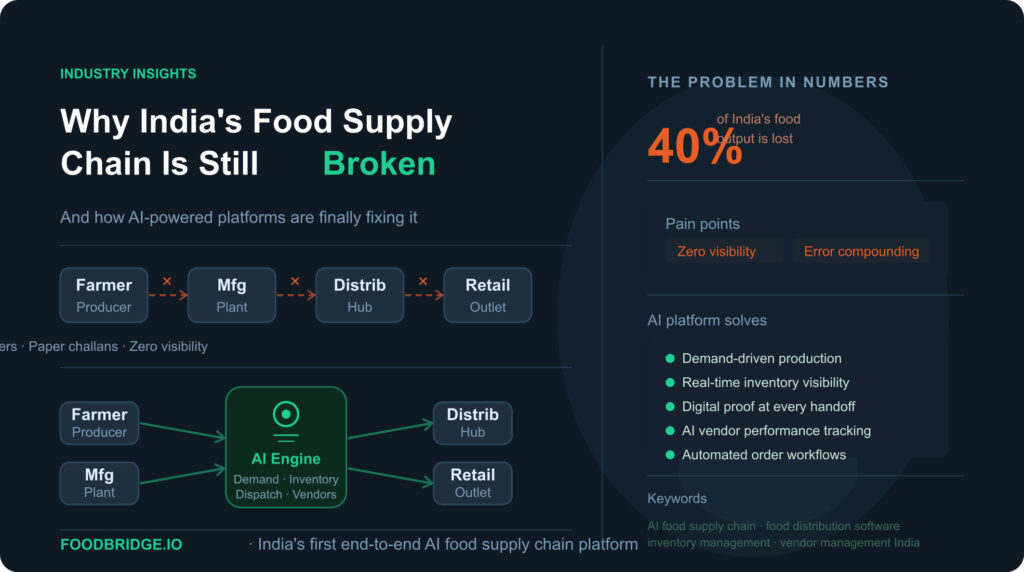
India produces enough food to feed its entire population — and then some. It is one of the world’s largest producers of milk, vegetables, fruits, and grains. And yet, somewhere between the farm and the fork, a staggering 33 to 40% of all food produced in India is lost. That is not a rounding error. That is a crisis.
Tonnes of perishables — milk, paneer, curd, fresh produce — spoil in transit or sit unsold in warehouses because the right buyer could not be connected to the right seller at the right time. Distributors operate on gut instinct and yesterday’s Excel sheets. Retailers place orders over WhatsApp. Manufacturers produce blindly, often overshooting or undershooting actual demand by margins that cost the entire chain.
The root cause? India’s food supply chain was never designed as a network. It evolved as a patchwork of disconnected nodes — each operating in isolation, each guarding its own data, and each creating friction that compounds at every handoff.
The good news: AI-powered food supply chain platforms are changing this — and India is finally waking up to the transformation.
The Anatomy of a Broken Food Supply Chain
To understand why AI matters so much, you first need to understand exactly where and how the current system fails. The problems are not random — they are structural, predictable, and deeply interconnected.
1. Every Node Is an Island
In a functioning supply chain, information flows freely from the retailer back to the manufacturer. Demand signals travel upstream. Inventory data travels downstream. Everyone operates with a shared view of reality.
In India’s food distribution ecosystem, that almost never happens.
Retailers share orders via WhatsApp voice notes. Distributors maintain their own Excel files — often updated once a day, sometimes less. Manufacturers rely on yesterday’s data to decide today’s production. By the time a demand signal reaches the production floor, it has been filtered through three or four layers of manual transcription, each introducing its own errors.
The result is what supply chain experts call information asymmetry — and it is the single biggest driver of food waste, stockouts, and inefficiency across the chain.
2. The Bullwhip Effect in Perishables
A small fluctuation in retail demand gets amplified as it moves upstream. A retailer orders 10% more than usual. The distributor, uncertain, orders 20% more than usual. The manufacturer, seeing the spike, produces 40% more. By the time the goods arrive, the retail surge has normalised — and now everyone is sitting on excess stock that cannot wait.
For perishables like milk, curd, and paneer, this is not an inconvenience. It is a financial catastrophe. Unlike a t-shirt or a spare part, these products do not wait for the market to catch up. They expire — and with them, the margins of every business in the chain.
3. Zero Visibility Means Zero Accountability
Ask a typical distributor the following questions:
- Where is Shipment #A4721 right now?
- Was that delivery of 500 units actually received by the retailer?
- Who is responsible for the spoiled goods that arrived at the cold storage yesterday?
In most cases, they cannot answer any of these with certainty. There is no digital trail. No timestamps. No verified proof of delivery. When a dispute arises — and in food distribution, disputes arise constantly — it becomes a WhatsApp argument backed by paper challans and handwritten receipts.
This is not just operationally painful. It erodes trust across the entire network. Without trust, every handoff becomes adversarial.
4. Manual Work, Duplicated at Every Level
Here is what a typical day looks like across the food supply chain in India:
- The retailer calls the distributor to place an order
- The distributor manually enters it into Excel
- The distributor calls the manufacturer to check availability
- The manufacturer checks a separate Excel file
- Someone types up a delivery challan — by hand
- A security guard at the gate verifies that challan — manually — for 30+ minutes
Now multiply this by hundreds of transactions a day, across dozens of nodes. The same data is entered, re-entered, and re-entered again. Every manual touchpoint is a chance for error. And errors, as we will see, do not stay local.
5. Error Compounding: How Small Mistakes Become Big Problems
This is perhaps the most underappreciated problem in food supply chains. A small data entry error at the retailer level — say, ordering 480 units instead of 500 — does not stay small. As demand aggregates upward through the distributor to the manufacturer, the error gets amplified.
By the time it reaches production planning, the distortion may be large enough to cause the manufacturer to produce the wrong quantity, dispatch the wrong amount, and trigger shortages or surpluses across the network. Supply chain professionals call this error compounding, and in food distribution, it is a daily reality.
Why Traditional Software Is Not Enough
You might be thinking: surely companies already use software to manage this? And yes, many do. But most food distribution businesses in India rely on one of three inadequate solutions:
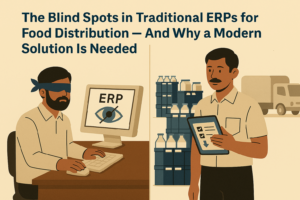
1. Generic ERP systems built for manufacturing or retail, not specifically for the complexity of multi-node food distribution networks with perishable constraints.
2. Basic inventory tools that track stock levels but cannot predict demand, flag spoilage risk, or coordinate across multiple suppliers and distributors simultaneously.
3. Excel and WhatsApp — which, despite everything, remain the dominant “tools” for order management and communication in much of the food distribution sector.
None of these give you the one thing a modern food business needs most: a real-time, unified view of your entire supply chain, from supplier to shelf.
Enter AI: What an AI-Powered Food Supply Chain Platform Actually Does
The shift from traditional software to an AI-powered food supply chain platform is not just a technology upgrade. It is a fundamental change in how the entire network operates.
Here is what that looks like in practice:
Demand-Driven Production
Instead of manufacturers guessing what to produce based on lagged Excel data, AI models analyse real-time demand signals from the retail end and generate production recommendations. The question changes from “how much did we sell last week?” to “how much will the market need tomorrow?”
For perishable products — where overproduction and underproduction both cost money — this is transformative.
Real-Time Inventory Visibility
A modern food supply chain management software powered by AI gives every stakeholder in the chain — manufacturer, distributor, retailer — a live view of inventory positions across all nodes. When stock runs low at one warehouse, the system flags it automatically. When goods are nearing expiry, the platform alerts the relevant parties to act before waste occurs.
This is what warehouse inventory management software is evolving into: not just a ledger of what is in stock, but an intelligent system that tells you what to do about it.
Automated Order Management and Vendor Coordination
AI platforms replace the WhatsApp-and-phone-call workflow with structured, digital order flows. Orders are placed through the platform, matched to available inventory, and routed to the appropriate supplier or distributor automatically. Vendor management software for food distributors built into the platform ensures that supplier performance — on-time delivery, order accuracy, spoilage rates — is tracked and visible to all parties.
This eliminates disputes before they start. There is now a single source of truth: the platform.
Digital Proof at Every Handoff
One of the most painful problems in food distribution is the “was it sent? was it received?” argument. AI-powered platforms solve this with digital delivery confirmation, QR-code-based challan verification, and timestamped records of every transaction.
When a retailer claims they received 480 units and the invoice says 500, the platform has the data to resolve the dispute in seconds — not days.
Supplier Performance and Risk Management
Supplier management software for distributors within an AI platform continuously evaluates vendor reliability, lead times, and quality metrics. If a particular supplier is consistently late or has high spoilage rates, the system flags them before their poor performance causes downstream damage.
This transforms vendor relationships from reactive (fixing problems after they happen) to proactive (preventing problems before they start).
The India-Specific Opportunity
India’s food supply chain is not just large — it is uniquely complex. It involves:
- Extreme diversity of products (dairy, produce, grains, processed foods) with vastly different shelf lives and handling requirements
- A fragmented distribution network with many small distributors and regional players
- Infrastructure challenges including inconsistent cold chain coverage
- A large informal sector where digital adoption is still nascent
This complexity is precisely what makes food supply chain software built specifically for India so critical — and so valuable. A solution designed for a European or American supply chain, with its different infrastructure and regulatory context, simply does not translate.
The opportunity for food stock management software in India is enormous. The businesses that adopt AI-driven platforms now will have a structural advantage over competitors who are still managing their networks on Excel and WhatsApp when the next wave of demand hits.
What to Look for in a Food Supply Chain Management Solution
If you are evaluating a supply chain management solution for your food business, here are the capabilities that separate genuinely transformative platforms from glorified spreadsheets:
- End-to-end network visibility — can you see all nodes (suppliers, distributors, warehouses, retailers) in one dashboard?
- AI-driven demand forecasting — does the platform predict demand, or just report historical data?
- Automated order and dispatch workflows — are manual WhatsApp and phone-call processes eliminated?
- Digital proof of delivery — is there an auditable record of every transaction?
- Perishability management — does the system account for shelf life, expiry dates, and FIFO inventory logic?
- Vendor performance tracking — can you measure and compare supplier reliability over time?
- India-specific architecture — is the platform designed for the structure of Indian food distribution networks, not adapted from a foreign market?
The Bottom Line
India’s food supply chain is broken. Not because the people in it are not hardworking or smart — they are. It is broken because the system was never architected for transparency, coordination, or real-time decision-making across a multi-node network.
AI is not a magic fix. But an AI-powered food supply chain platform that connects every node, eliminates manual errors, forecasts demand accurately, and creates digital accountability at every handoff is the closest thing the industry has seen to a structural solution.
The 33–40% food loss figure does not have to be a constant. With the right food supply chain management software, Indian distributors, manufacturers, and retailers can work as a network — not as a collection of isolated islands — and begin to reclaim those losses, one shipment at a time.
FoodBridge.io is India’s first end-to-end AI supply chain platform built specifically for the food ecosystem — connecting manufacturers, distributors, retailers, and suppliers on a single, intelligent network.

One Response