
Food Safety Compliance Software: The Missing Piece for Punjab’s Food Distributors
Walk into any distribution warehouse in Mohali, Ludhiana, or Zirakpur during an FSSAI inspection week, and you will see the same scene repeating itself. Someone is digging through a drawer of vendor licenses. Someone else is scrolling through WhatsApp trying to find the photo of a batch certificate sent three months ago. This is the reality that food safety compliance software exists to end, and for Punjab’s food distributors, sitting at the center of one of India’s busiest agricultural and food processing corridors, it has stopped being optional.
Punjab’s food economy runs on volume and speed. Grain, dairy, produce, and processed goods move through Mohali’s industrial belt and out toward Chandigarh, Haryana, and Delhi NCR every single day, often through networks of dozens of small and mid-sized vendors rather than a handful of large suppliers. That scale is exactly what makes manual compliance tracking so fragile here. A license that was valid when a vendor was onboarded eighteen months ago may have quietly lapsed. A batch that triggered a client complaint last month may have no traceable documentation tying it back to its source. None of this shows up as an emergency until an FSSAI officer or a large retail buyer asks for proof, and by then it is too late to reconstruct calmly.
The Punjab-Specific Pressure Points
Distributors operating out of Punjab face a compliance load that looks different from a single-city retailer managing one warehouse. Seasonal harvest cycles mean vendor rosters expand and contract throughout the year, which means certification tracking has to keep pace with vendors who may only supply for a few months at a time. Cross-border movement into Haryana and Delhi NCR adds state-level documentation requirements on top of the central food safety standards laid out by the FSSAI. And because much of Punjab’s food distribution still runs through informal or semi-formal vendor relationships, certification paperwork often exists as a photo on someone’s phone rather than a searchable record.
This is where the gap between being technically compliant and being able to prove it in under five minutes becomes expensive. An audit that should take an afternoon stretches into a week of frantic searching. A retail client that wants to see quality documentation before renewing a contract gets a delayed, incomplete answer instead of an immediate one. Trust, once shaken over paperwork, is hard to rebuild.
What Compliance Software Changes on the Ground
A proper food safety compliance system does not replace the relationships Punjab’s distributors have built with their vendors over years. It protects those relationships by making sure compliance never becomes the reason a good vendor gets flagged or a good client walks away.
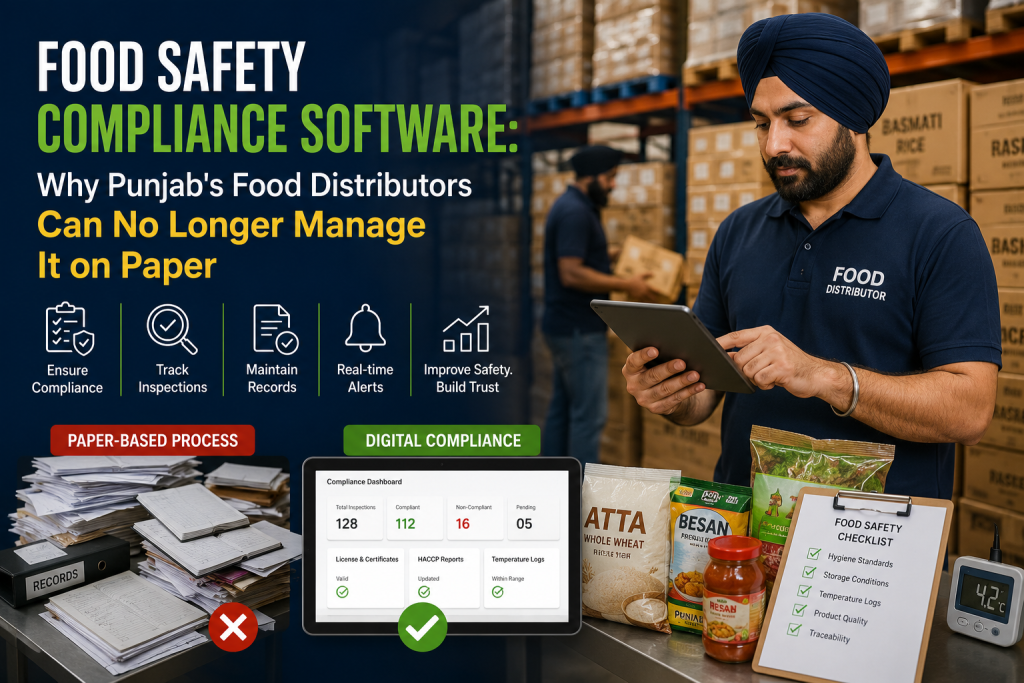
The first shift is centralization. Every FSSAI license, every vendor certification, every batch quality record moves into one searchable system instead of living across drawers, phones, and inboxes. When an inspector or a client asks for proof, it is a lookup, not an investigation.
The second shift is proactive expiry tracking. Instead of discovering that a vendor’s license lapsed only after a shipment gets held at a checkpoint, the system flags the renewal window weeks in advance, giving the distributor time to act before it becomes a compliance failure rather than an administrative task.
The third shift is batch-to-source traceability. If a quality complaint comes in on a specific consignment, the full chain, which vendor supplied it, which batch it belongs to, how it was handled and stored, is available immediately. For a business built on trust with retail buyers, being able to answer where something came from instantly is often what separates a manageable issue from a lost client.
The fourth shift is consistency across locations. A distributor running operations out of one Mohali warehouse can get away with informal tracking longer than one running three or four locations across Punjab and into Haryana. Compliance software makes sure every location produces documentation in the same format, so an audit does not turn into a scavenger hunt through inconsistent filing systems built by different people at different times.
Why This Connects Directly Back to Vendor Management
Compliance and vendor management are not separate problems, even though most distributors treat them that way. A vendor whose FSSAI certification has lapsed is a vendor who should not be receiving new purchase orders, but that connection only happens automatically if the systems talk to each other. This is the same disconnect that shows up when distributors rely on scattered spreadsheets instead of proper vendor management software for food distributors to track supplier reliability alongside certification status. A vendor management system that does not track certification status is only solving half the problem.
Many of the losses Punjab and Haryana distributors quietly absorb trace back to exactly this kind of disconnect between vendor records and compliance status.
Getting Compliance-Ready Without Starting From Zero
Most distributors assume moving to compliance software means digitizing everything overnight, which is precisely why many put it off. A realistic starting point looks different. Begin by centralizing the FSSAI and vendor certification documents that already exist, even if they start out as scanned copies. Add expiry alerts on whichever licenses are currently tracked only in someone’s memory or a calendar reminder. Then extend batch traceability first to the SKUs most likely to generate a quality complaint, rather than trying to cover the entire catalog on day one.
Once that foundation is in place, audit season stops being something the whole team dreads weeks in advance. It becomes a formality, because the proof was always there, organized and current, the moment anyone asked for it.
For a food economy built on trust between farmers, distributors, and retailers the way Punjab’s is, compliance software is not about satisfying a regulator. It is about making sure that trust never has a reason to break over a missing piece of paper.
Conclusion
Compliance was never meant to be the hardest part of running a food distribution business in Punjab. It became that way only because paperwork stayed manual while everything else around it, from vendor networks to delivery routes, scaled up. Food safety compliance software does not add another layer of work; it removes the guesswork that turns a routine audit into a week of stress and a single missing certificate into a lost client. For distributors who have spent years building trust across mandis, warehouses, and retail counters, that trust deserves a system that can prove it instantly, not one that leaves it hanging on a phone screenshot.
Ready to Eliminate Compliance Guesswork?
Stop reconstructing compliance records under pressure during audit season. Book a FoodBridge demo and see how audit-ready documentation runs in the background, automatically, for distributors across Punjab and Haryana.
Frequently Asked Questions
What is food safety compliance software for distributors?
It is a system that centralizes FSSAI licenses, vendor certifications, and batch quality records in one place, with automated expiry alerts and full batch-to-source traceability, so distributors can prove compliance instantly instead of reconstructing it during an audit.
Is FSSAI compliance different for distributors in Punjab compared to other states?
The core FSSAI requirements are national, but Punjab distributors often deal with added complexity from seasonal vendor turnover tied to harvest cycles and cross-border movement of goods into Haryana and Delhi NCR, both of which increase how often certifications need tracking and renewal.
How does compliance software connect with vendor management?
A vendor whose license has lapsed should automatically be flagged before new orders are placed. Compliance software only delivers this if it shares data with the vendor management system, rather than running as a separate, disconnected tool.
Can smaller distributors benefit from compliance software, or is it only for large operations?
Smaller distributors often benefit the most, since they typically have the least formal documentation in place to begin with. Starting with just certification centralization and expiry alerts, without a full system overhaul, is usually enough to close the biggest audit-time gaps.
What happens if a vendor’s FSSAI license expires without anyone noticing?
Any shipment tied to that vendor can be held or rejected during an inspection, and any product already delivered becomes difficult to defend during a quality complaint, since the paperwork behind it is no longer valid.