

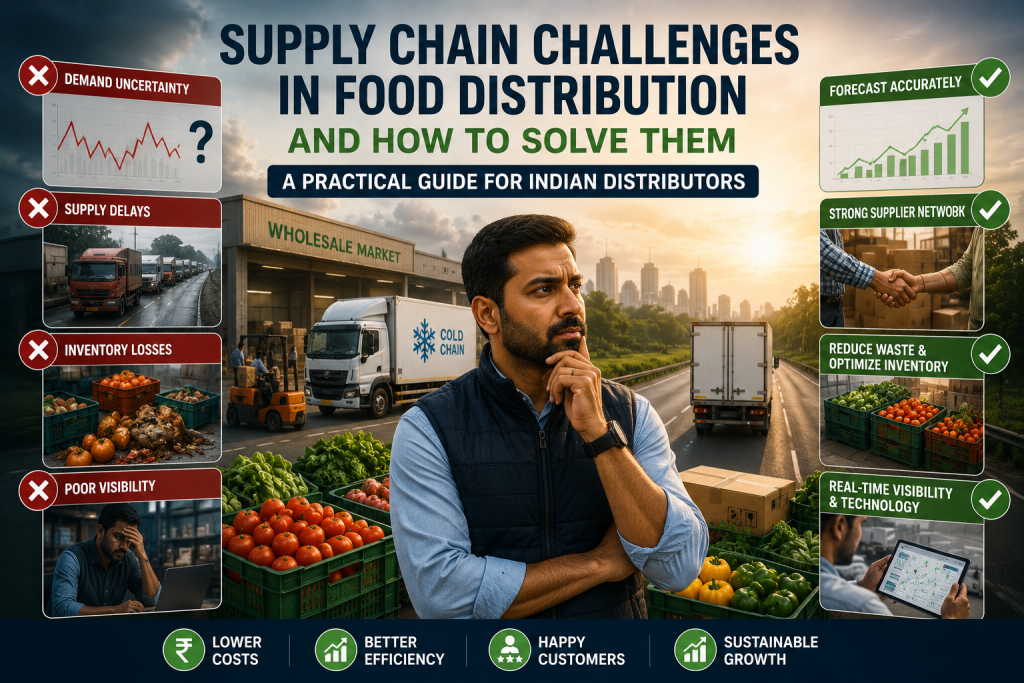
Gurpreet has been running a food distribution business in Ludhiana for fourteen years. He distributes packaged goods, dairy products, and dry staples to over three hundred retailers across three districts in Punjab. By any measure, his is a successful, well-established business. But if you ask Gurpreet what keeps him up at night, he will not talk about competition or margins. He will talk about the supply chain challenges in food distribution that have been part of his daily reality for over a decade — the supplier who delivered short last Tuesday, the batch of products that arrived closer to expiry than agreed, the order that went wrong because nobody could confirm in real time what was actually in the warehouse. These are not catastrophic problems. They are quiet, persistent ones — and they cost him more than he can accurately calculate.
Gurpreet’s situation is not unusual. Across Punjab and Haryana, food distributors of every size are navigating a supply chain environment that is uniquely demanding — shaped by extreme seasonal pressures, fragmented supplier networks, perishable product categories, and a distribution infrastructure that is still catching up with the speed and complexity of modern food trade.
The Problem With Supplier Reliability
The first and perhaps most fundamental supply chain challenge for food distributors in this region is supplier reliability. Punjab and Haryana are among India’s most productive agricultural and food manufacturing states — which means there is no shortage of suppliers. But having many suppliers available is not the same as having reliable ones, and for a distributor like Gurpreet who depends on consistent, on-time delivery of specific quantities and quality levels, the gap between availability and reliability is where most of his operational headaches begin.
Supplier delays are rarely dramatic. They are usually a matter of hours or a day — a truck that left late, a batch that was not ready when promised, a quantity that fell slightly short of the purchase order. Individually, each of these feels minor. Collectively, across dozens of supplier relationships and hundreds of deliveries per month, they create a ripple effect that reaches all the way to the retailer end of the supply chain. Gurpreet’s retailers do not care that his supplier was a day late. They care that their order arrived incomplete and their shelves are empty.
The solution starts with measurement. Distributors who begin tracking supplier performance systematically — delivery timing, quantity accuracy, product quality consistency — gain the data needed to have specific, evidence-based conversations with suppliers rather than vague complaints that are easy to dismiss. Over time, this data also reveals which supplier relationships are worth investing in and which are quietly costing the business more than they contribute.
Inventory Visibility — The Problem Nobody Talks About Directly
The second major supply chain challenge in food distribution is one that is rarely named directly but is felt constantly: inventory visibility. Most food distributors in Punjab and Haryana do not have a reliable, real-time picture of what stock they actually hold at any given moment. They have an approximate picture — based on the last manual count, updated by memory of recent deliveries and dispatches — but approximate is not the same as accurate, and in food distribution, inaccuracy has a direct cost.
When a sales rep takes an order for a product that the warehouse believes is in stock but actually is not, the resulting shortfall damages the distributor’s relationship with that retailer. When a purchase order is placed for stock that is already sufficient because nobody checked the current inventory level accurately, the resulting overstock ties up working capital and creates expiry risk. These are the hidden costs of poor supply chain visibility — not dramatic losses but a constant, grinding inefficiency that compounds over time.
The fix for this is straightforward in concept but requires discipline in execution: every inbound delivery and every outbound dispatch must be recorded in real time, in the same system, by everyone involved in warehouse operations. When this discipline exists, the inventory picture is always current. When it does not, the picture is always slightly wrong — and slightly wrong at scale becomes seriously wrong.
Managing Expiry Risk Across a Perishable Portfolio
The third challenge is one that is specific to food distribution in a way that simply does not apply to most other industries: managing expiry risk across a portfolio that includes products with shelf lives ranging from a few days to several months.
For Gurpreet, whose product range includes both fresh dairy and long-shelf-life packaged goods, this challenge requires managing two fundamentally different inventory disciplines simultaneously. The dairy side requires FEFO discipline — dispatching products by expiry date rather than arrival date — executed consistently across every picking decision every day. The packaged goods side requires reliable reorder systems that account for seasonal demand variations, particularly around harvest seasons and festivals that create sharp, short-lived spikes in specific product categories.
The distributors who manage expiry risk most successfully across Punjab and Haryana are the ones who have moved beyond manual tracking to systems that automatically flag which batches need to move first and alert the team when specific products are approaching their expiry threshold. Read more about how this works in practice in our detailed guide on managing expiry stock in food businesses across Punjab and Haryana.
Demand Forecasting in a Market Driven by Seasons and Festivals
The fourth challenge is demand forecasting — and in Punjab and Haryana, this is particularly complex because demand in this region is heavily shaped by factors that do not follow a simple monthly pattern. Lohri, Baisakhi, Diwali, the wheat harvest season, the paddy harvest season — each of these creates predictable but sharp variations in demand for specific product categories that require advance planning to handle without either running out or overstocking.
Most food distributors in this region forecast demand informally — based on memory of previous years and gut feel about the current season. This works reasonably well for experienced distributors who have seen several cycles of demand variation. But it leaves significant money on the table in terms of missed sales during peak periods and unnecessary carrying costs during slow periods.
A more structured approach to demand forecasting — using historical sales data broken down by product, region, and time period — allows distributors to make procurement decisions that are calibrated to actual demand patterns rather than rough approximation. Even a modest improvement in forecast accuracy can meaningfully reduce both stockouts during peaks and overstock during troughs, directly improving both revenue and margin.
The Order Management Gap
The fifth challenge is order management — specifically, the gap between how orders are placed, confirmed, and tracked in most food distribution businesses and what buyers actually need to feel confident in their supplier relationship.
In most distribution businesses across this region, orders are still placed and managed through a combination of phone calls, WhatsApp messages, and manual entry into systems that are not connected to live inventory data. The result is a process that is slow, error-prone, and opaque from the buyer’s perspective. A retailer who places an order has no reliable way to know when it will arrive, what its status is, or whether everything they ordered is actually available — until the delivery truck either shows up or does not.
This is where a purpose-built food distribution management platform makes a difference that is immediately visible to buyers. When order status is trackable, when inventory is connected to order taking, and when exceptions are flagged automatically rather than discovered at the point of delivery, the buyer experience improves in ways that build loyalty more effectively than any amount of relationship management.
Conclusion
Supply chain challenges in food distribution are not going to disappear. The complexity of managing perishable products through fragmented supplier networks, across seasonal demand cycles, with thin margins and high buyer expectations is a structural feature of the food distribution business in Punjab and Haryana — not a temporary problem waiting for a permanent fix.
What changes is a distributor’s ability to navigate these challenges. The difference between a distribution business that is constantly firefighting and one that is consistently growing is not luck or market conditions. It is the quality of the systems and visibility tools that allow the business to see problems before they become crises and act on data rather than assumptions.
For food distributors across Punjab and Haryana who are ready to build that kind of operational clarity, FoodBridge is the platform built for exactly this environment.
🔗 See how FoodBridge helps food distributors solve supply chain challenges → foodbridge.io/product
Frequently Asked Questions
What are the biggest supply chain challenges in food distribution in India?
The most significant challenges include supplier reliability and delivery consistency, real-time inventory visibility, expiry risk management across perishable products, demand forecasting in seasonal markets, and order management transparency from placement to delivery.
How can food distributors in Punjab and Haryana improve supplier reliability?
By systematically tracking supplier performance — delivery timing, quantity accuracy, and product quality — distributors can identify recurring issues with specific suppliers and have evidence-based conversations that lead to real improvement. Over time, this data also guides procurement strategy toward the most reliable supplier relationships.
Why is inventory visibility such a critical issue for food distributors?
Because inaccurate inventory data creates a cascade of problems — missed sales, duplicate orders, expiry losses, and damaged buyer relationships — each of which has a direct financial cost. Real-time inventory visibility eliminates these costs by ensuring that every decision is made on accurate, current information.
How does demand forecasting help food distributors manage seasonal peaks?
Structured demand forecasting using historical sales data allows distributors to anticipate peak demand periods — festivals, harvest seasons, weather events — and adjust procurement in advance. This reduces both stockouts during peaks and unnecessary carrying costs during slow periods.
How does FoodBridge help solve supply chain challenges in food distribution?
FoodBridge provides an integrated platform that connects supplier management, real-time inventory tracking, expiry monitoring, order management, and demand visibility into one system — giving food distributors across India the operational clarity needed to reduce losses, improve buyer relationships, and scale their business sustainably.

One Response