
Knowing how to forecast demand in seasonal food business is essential for any distributor aiming to stay competitive in a constantly changing market. Demand in the food industry is never stable—it shifts with seasons, festivals, weather conditions, and evolving consumer preferences.
In such a dynamic environment, relying on guesswork can lead to serious challenges like overstocking, spoilage, or missed sales opportunities. Businesses that fail to anticipate demand fluctuations often struggle with inefficient inventory planning and disrupted operations.
This is why understanding how to forecast demand in seasonal food business is not just a strategy—it’s a necessity for maintaining balance between supply and demand, reducing waste, and ensuring consistent growth.
Why Forecasting Is Crucial in Seasonal Business
Unlike stable industries, seasonal businesses experience sharp fluctuations. A product that sells moderately throughout the year may suddenly see a surge during a specific period.
Without proper forecasting, businesses often react too late. They either rush to procure stock at higher costs or struggle to clear excess inventory after the season ends.
Effective forecasting helps align procurement, inventory, and sales strategies. It ensures that the right products are available at the right time, without unnecessary waste.
Understanding Demand Drivers
To forecast accurately, it’s important to understand what influences demand.
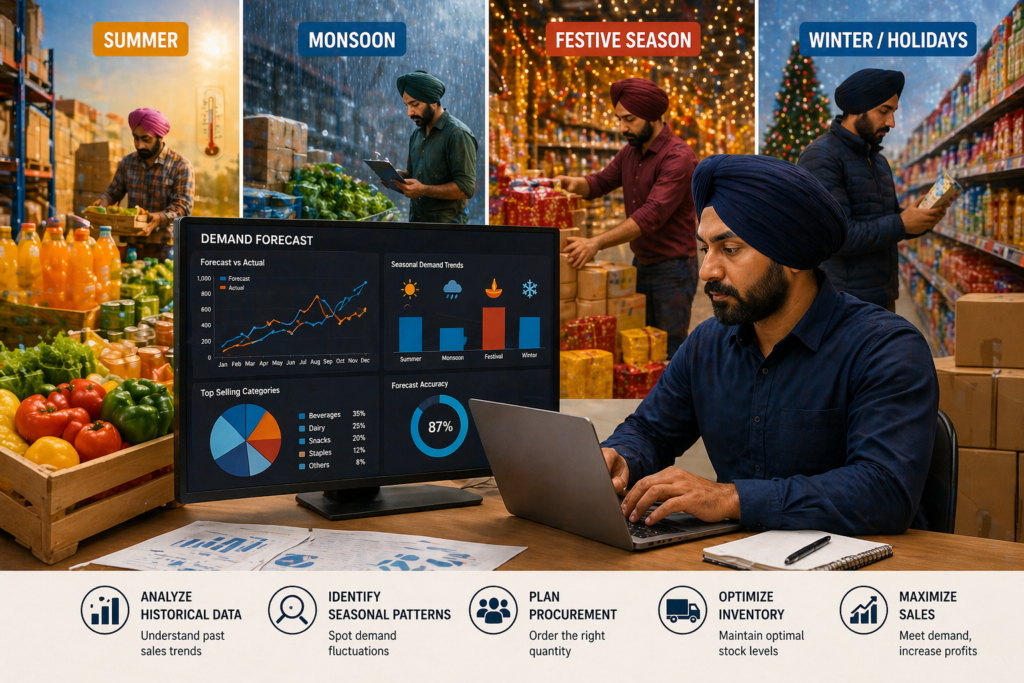
Seasonality is the most obvious factor. Products like beverages, dairy, or festive items have predictable demand cycles. However, other factors such as weather changes and cultural events also play a significant role.
For example, an unexpected heatwave can increase demand for cold beverages, while extended rainfall may disrupt supply and affect purchasing behavior.
Historical sales data provides valuable insights into these patterns. By analyzing past trends, businesses can identify recurring demand cycles and prepare accordingly.
Moving Beyond Guesswork
Many small and mid-sized distributors rely on intuition or past experience for forecasting. While experience is valuable, it is not always reliable in a dynamic market.
A more structured approach involves analyzing data and identifying patterns. By studying previous sales, businesses can estimate future demand with greater accuracy.
This process forms the foundation of effective inventory management for food distributors, ensuring that stock levels are aligned with expected demand.
The Role of Real-Time Data
Forecasting is not a one-time activity. Demand patterns can change quickly, and relying only on historical data is not enough.
Real-time sales data provides a more accurate picture of current demand trends. By monitoring how products are performing daily, businesses can adjust their forecasts and procurement plans accordingly.
This flexibility is especially important during seasonal peaks, where demand can shift rapidly.
Segmenting Products for Better Planning
Not all products behave the same way. Some have strong seasonal demand, while others remain stable throughout the year.
By categorizing products based on their demand patterns, businesses can plan more effectively. High-demand seasonal products require careful forecasting and timely procurement, while stable products need consistent stock levels.
This segmentation simplifies decision-making and reduces the risk of overstocking or understocking.
Aligning With Suppliers
Demand forecasting is not just an internal process—it requires coordination with suppliers.
When suppliers are informed about expected demand in advance, they can plan their production and logistics accordingly. This reduces the chances of last-minute shortages or delays.
Effective collaboration improves overall food supply chain management and ensures smoother operations during peak seasons.
Leveraging Technology for Accurate Forecasting
Manual forecasting methods are often limited in accuracy and scalability.
By using inventory management software for food business or a food supply chain software, businesses can automate data analysis and generate more accurate forecasts. These tools can process large volumes of data, identify trends, and provide actionable insights.
A supply chain visibility platform further enhances this process by offering real-time information on inventory and demand. This allows businesses to make quick adjustments and stay aligned with market conditions.
Reducing Waste Through Smart Planning
One of the biggest challenges in seasonal food businesses is managing perishable inventory.
Accurate forecasting helps reduce waste by ensuring that stock levels are aligned with actual demand. It also supports better stock rotation practices, minimizing the risk of expired products.
This not only improves profitability but also enhances operational efficiency.
How Technology Like Foodbridge Helps
Digital platforms are transforming how businesses approach demand forecasting. A modern digital supply chain platform integrates data from multiple sources—sales, inventory, and suppliers—to provide a complete picture of operations.
Foodbridge enables distributors to forecast demand more accurately, plan procurement efficiently, and respond quickly to changes. By bringing all processes into one system, it reduces uncertainty and improves decision-making.
Conclusion
Forecasting demand in a seasonal food business is both a challenge and an opportunity. Businesses that rely on guesswork often struggle with inefficiencies, while those that adopt data-driven approaches gain a significant advantage.
By combining historical data, real-time insights, supplier collaboration, and advanced technology, distributors can manage seasonal demand with confidence.
In a market where timing is everything, accurate forecasting is not just beneficial—it is essential for sustainable growth.