
A Practical Guide for Punjab & Haryana Distribution Businesses
In Punjab and Haryana, warehouse work begins early in the day. Before deliveries start and before the rush of orders begins, there is one task that quietly decides how the entire day will go—stock tracking.
Many businesses overlook this simple activity. Some do it in a hurry. Some skip it completely, thinking they will manage later. But by the end of the day, confusion starts building. Items are missing, numbers don’t match, and teams spend hours trying to figure out what went wrong.
Daily stock tracking is not just a routine task. It is the backbone of a smooth distribution business.
Why Daily Stock Tracking Matters More Than You Think
In a warehouse, nothing stays still. Products are constantly moving. New stock arrives, old stock gets dispatched, some items return, and some get damaged. This movement never stops, especially in food distribution businesses where speed is everything.
If you do not track these movements daily, your records slowly lose accuracy. At first, the difference between physical stock and recorded stock may be small. But over time, it becomes bigger and harder to fix.
This is why so many distributors keep searching for how to track stock in warehouse efficiently. The answer is not complicated, but it requires consistency.
Daily tracking ensures that what you see in your system matches what is actually present in your warehouse. When this alignment is lost, decision-making becomes weak, and losses begin to increase.
The Problem With Manual Tracking
In many warehouses across Punjab and Haryana, stock is still managed using registers, Excel sheets, and phone calls. While this method may seem simple, it creates multiple gaps in the system.
Manual entries are often delayed. Sometimes they are forgotten. Sometimes different people maintain different records, leading to confusion. By the end of the day, no one has complete clarity about what actually happened.
For example, a product may be dispatched but not recorded immediately. Another product may be received but entered later. These small delays create mismatches that grow over time.
This is the stage where businesses realize they need something more reliable, like
inventory management software for food business. Such tools remove dependency on memory and manual effort, bringing accuracy into daily operations.
What Daily Stock Tracking Should Actually Include
Tracking stock daily is not just about counting items on shelves. It is about understanding everything that happens inside the warehouse throughout the day.
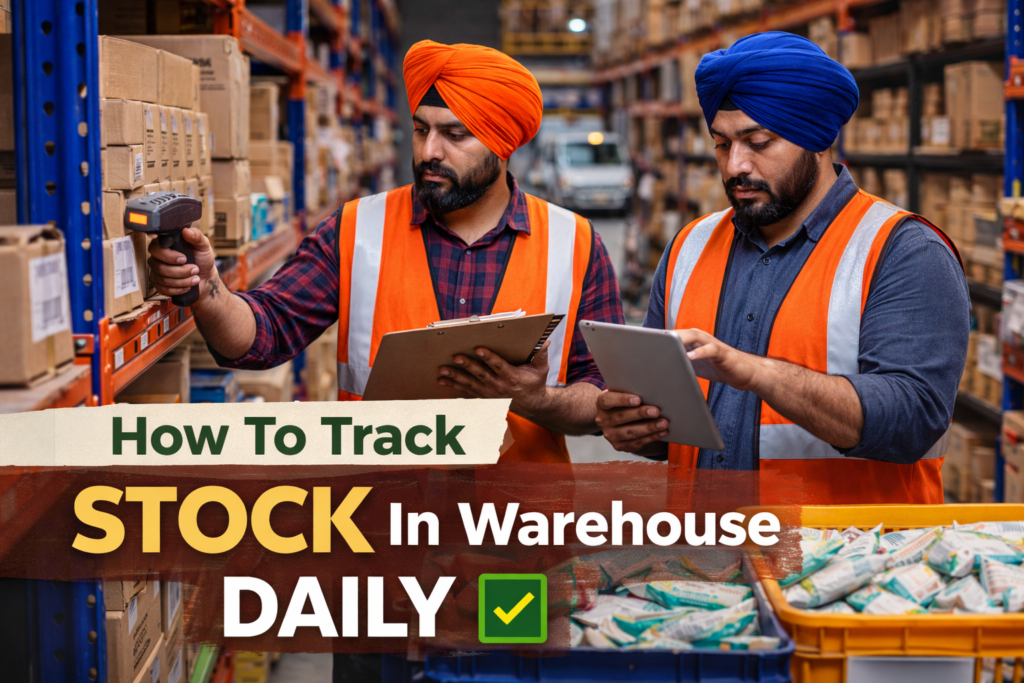
Every incoming product must be recorded at the time of arrival. Every outgoing item must be tracked during dispatch. Returns should be properly checked and updated. Damaged goods must be identified and removed from active stock.
If even one part of this process is missed, the entire system becomes unreliable.
This is where a structured supply chain management solution becomes important. It connects all these activities into one system, ensuring that nothing is missed.
How Real-Time Tracking Changes Everything
When businesses shift to digital systems, tracking becomes faster and more accurate.
A good warehouse management software records stock movement in real time. This means the moment a product enters or leaves the warehouse, the system is updated instantly.
You no longer need to wait until the end of the day to understand your stock position. You can check it anytime.
This visibility brings confidence. Managers know exactly what is available. Sales teams know what they can promise. Warehouse staff know what needs to be done next. Modern food distribution software is designed to make this process smooth and effortless.
Small Mistakes That Create Big Problems
Stock mismatches are rarely caused by one big mistake. They are usually the result of many small errors.
Sometimes products are placed in the wrong location. Sometimes expiry dates are not checked. Sometimes counting is rushed because of workload. Sometimes entries are skipped thinking they will be updated later.
Each of these mistakes looks small at the moment. But together, they create confusion that becomes difficult to manage. Using a proper inventory and distribution software helps reduce these errors by creating a structured workflow.
Daily Tracking Improves More Than Just Inventory
When stock is tracked properly, the impact is visible across the entire business.
Orders are processed faster because there is no confusion about availability. Deliveries become more accurate because the right items are picked and packed. Customer satisfaction improves because commitments are met on time.
Daily tracking also helps in planning better. Businesses can understand which products are moving quickly and which are slow. This improves purchasing decisions and reduces unnecessary stock.
This is why many experts consider it the best way to manage food distribution operations.
Why Punjab & Haryana Businesses Need Faster Systems
The distribution environment in Punjab and Haryana is very dynamic. Demand changes quickly. Retailers place multiple orders in a single day. External factors like weather and festivals influence sales.
In such a fast-moving environment, manual systems struggle to keep up. A modern food supply chain software adapts to this speed. It updates continuously, helping businesses stay prepared instead of reacting late.
Final Thought
Tracking stock daily is not an extra burden. It is a smart habit that builds a strong business.
When you track inventory properly, you reduce losses, avoid confusion, and improve efficiency. Your team works better, your customers stay happy, and your operations become smoother.
At the end of the day, success in distribution is not just about selling more.
It is about knowing exactly what you have—and using it wisely.