
A Practical Guide for Haryana & Punjab’s Food Industry
If you run a distribution business in Haryana or Punjab, you already know one truth:
Inventory doesn’t just sit on a shelf — it moves, leaks, disappears, expires, gets delayed, and creates daily chaos.
From dairy distributors in Karnal, to FMCG wholesalers in Ludhiana, to grain & staples suppliers in Zirakpur, every business owner in this belt faces the same question:
“How do I manage inventory without losing money, customers, or my sanity?”
This blog breaks down why inventory goes out of control — and how the right supply chain management solution can transform your operations overnight.
✅ 1. Inventory Problems Start With a Broken Supply Chain Network
Most distributors assume their supply chain is simple:
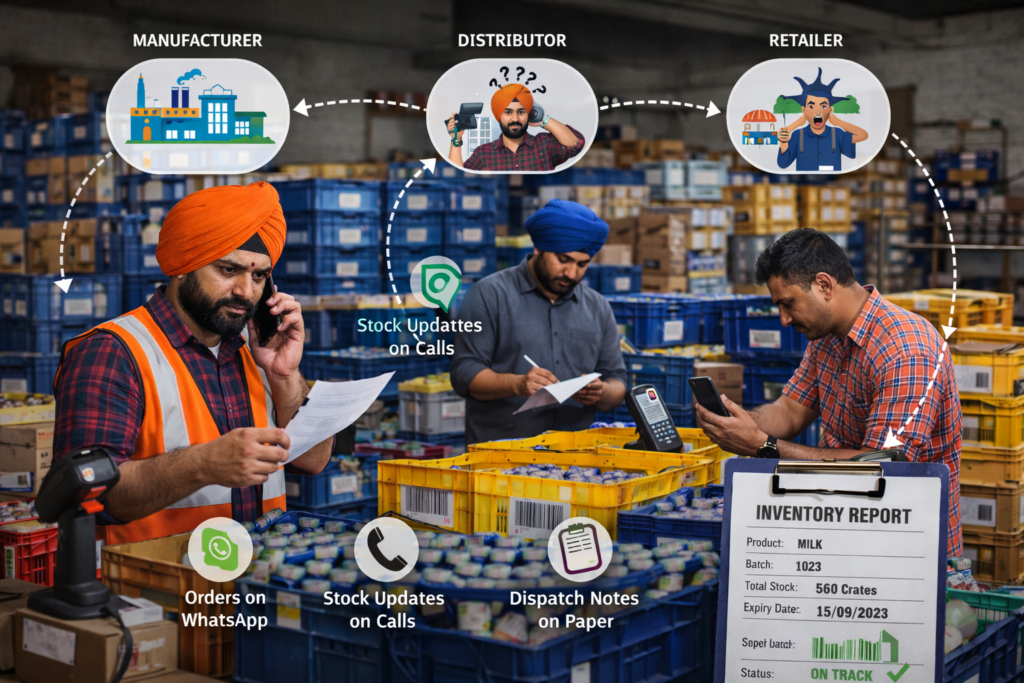
Manufacturer → Distributor → Retailer → Customer
But on the ground — in Ambala, Patiala, Sirsa, or Mohali — it never works that way.
The reality is a messy network:
- Orders on WhatsApp
- Stock updates on calls
- Dispatch notes on paper
- Returns scribbled in diaries
Every node operates separately, causing:
- Miscommunication
- Wrong forecasting
- Excess inventory
- Stockouts
This is exactly why modern distributors in the region are shifting to supply chain software for food industry — because manual processes simply can’t handle today’s pace.
✅ 2. Manual Inventory Management = Guaranteed Losses
If you use Excel + WhatsApp + verbal updates, you’ve already experienced these problems:
● Overstocking of fast‑moving goods
You buy more to avoid stockouts — but it blocks cash.
● Expiry loss in perishable items
Milk, dahi, paneer, bakery items — even a 2‑hour delay can spoil your stock.
● Retailers changing demand last minute
One wrong WhatsApp message throws off your entire day’s plan.
● Inaccurate stock counts
Paper challans don’t match physical inventory. Arguments start. Trust drops.
● No real‑time visibility
You never know what exactly moved today until the team reports at night.
This is why inventory headaches feel never‑ending.
You’re not mismanaging —
the system you’re using is outdated.
✅ 3. Real-Time Inventory Is the Only Way Forward
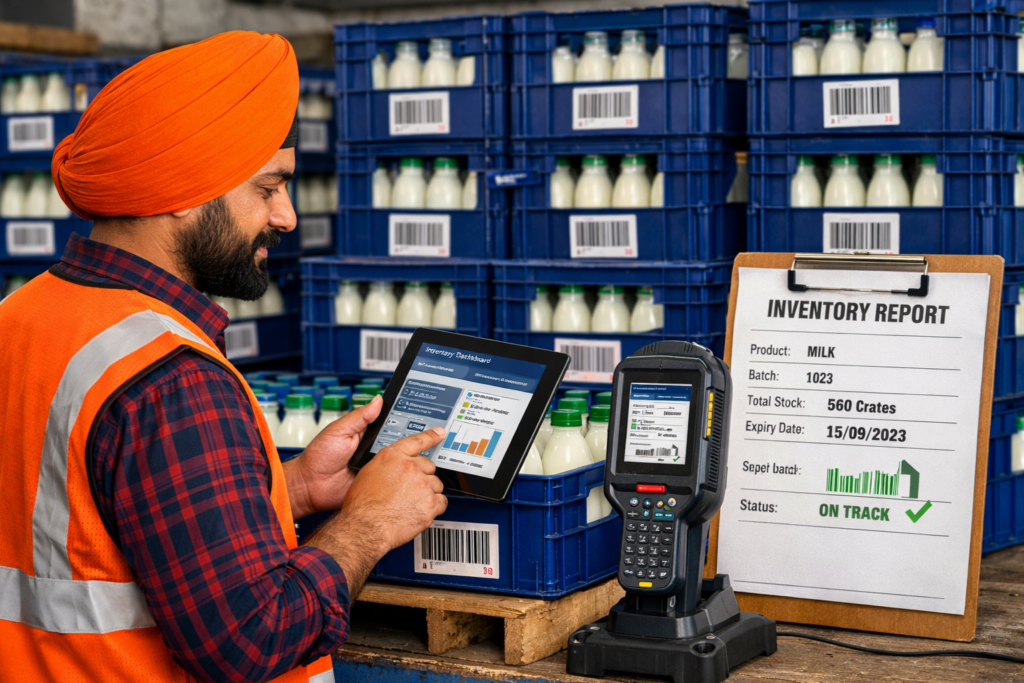
Across Haryana & Punjab, distributors are now switching to food supply chain software that gives instant visibility of:
- Stock in warehouse
- Stock in transit
- Stock reaching retailers
- Real-time orders
- Returns and replacements
- Batch-level expiry
- Fast & slow-moving items
- Forecasted demand for next week
This is not “software for IT people.”
This is survival tech for businesses built on perishable and semi‑perishable products.
✅ 4. How a Supply Chain Management Solution Fixes Daily Inventory Chaos
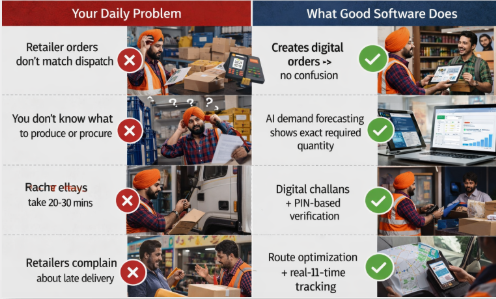
Let’s map real issues to real solutions:
| Your Daily Problem | What Good Software Does |
| Retailer orders don’t match dispatch | Creates digital orders → no confusion |
| You don’t know what to produce or procure | AI demand forecasting shows exact required quantity |
| Stock goes missing | Batch-level tracking + digital proof |
| Gate delays take 20–30 mins | Digital challans + PIN-based verification |
| Disputes on quantity delivered | Photo + timestamp + digital trail |
| Retailers complain about late delivery | Route optimization + real-time tracking |
This is why the smartest businesses are adopting supply chain software for food industry — not because it’s fancy, but because it stops money from leaking every day.
✅ 5. Haryana & Punjab Demand Moves Fast — Your Inventory System Must Move Faster
Business here is different.
People don’t order weekly — they order:
- Multiple times a day
- Based on temperature
- Based on festivals
- Based on milk cycles
- Based on unexpected demand spikes
Manual systems simply can’t keep up.
A modern food supply chain software updates itself every minute — just like your business moves every minute.
✅ 6. Inventory Management Isn’t About Counting Stock — It’s About Predicting It
The best distributors in the region don’t just track inventory…
They see tomorrow’s demand today.
With the right supply chain management solution, you get:
- Predictive inventory analytics
- Auto-suggestions for reorder quantities
- Alerts for expiring batches
- Sales pattern insights
- Real-time mismatch detection
- Automated purchase planning
This means:
- No overstock
- No stockouts
- No expired goods
- No unnecessary losses
- No retailer dissatisfaction
Your business becomes proactive, not reactive.
✅ Final Word: Inventory Issues Are Not Your Fault — But Solving Them Is Your Responsibility
Haryana and Punjab’s distribution market is growing fast, but margins are shrinking.
Those who continue managing inventory manually will keep bleeding profits quietly.
Those who adopt modern supply chain management solutions will scale — smoothly, confidently, predictably.
Inventory is not a problem.
Your system is.
And upgrading it is not an expense — it’s insurance against unnecessary loss.