


In Punjab and Haryana, food is not just business. It is pride. It is hard work that begins before sunrise—fields covered in mist, trucks lining up near mandis, warehouses unlocking their shutters before the day even starts. Food distributors here don’t just move products; they move the effort of farmers, the expectations of retailers, and the trust of customers.
Yet behind this movement lies a quiet struggle—inventory.
Every food distributor knows this feeling. The stock should be there, but it isn’t. Or worse, it is there, but already expired. Orders are coming in, sales teams are calling, warehouses are rushing, and suddenly everything feels out of control. This is not because distributors don’t work hard. It is because inventory today has become too complex to manage without the right system.
When Stock Exists on Paper, But Not in Real Life
Many distributors will relate to this moment. A retailer from Ludhiana places an urgent order. The sales team checks the system—stock looks available. Commitment is made. But when the warehouse team goes to pick the goods, the batch is missing or already damaged.
That sinking feeling is familiar.
This happens because inventory data is not live. It is updated later, manually, or not at all. Multiple registers, Excel sheets, and partial systems create an illusion of control. This inventory mismatch is one of the biggest supply chain problems in the food industry.
Emotionally, this hurts. You feel embarrassed in front of customers. You feel angry at your own system. You feel helpless because the mistake was invisible until it was too late.
Supply chain software built for food distribution removes this blind spot by showing exactly what stock is available, where it is stored, and in what condition—right now, not yesterday.
Expiry Dates That Don’t Announce Themselves
Food doesn’t wait. Milk doesn’t wait. Frozen items don’t wait. And yet expiry often comes silently.
In many warehouses, older stock sits behind newer stock. Labels fade. Manual checks get skipped on busy days. Before anyone realises, cartons have crossed their expiry date. The loss is not just financial—it feels personal. Someone worked hard to produce that food, and it now goes to waste.
This is one of the most painful challenges in food distribution business.
Technology introduces batch-wise tracking and expiry visibility. FIFO and FEFO inventory methods stop being textbook concepts and start becoming daily practice. Alerts give you time to act. You can discount, redirect, or move stock before it turns into loss.
This is how distributors learn not just how to manage food inventory, but how to protect it.
The Weight of Overstocking and the Fear of Running Out
Every distributor has faced this dilemma. One product is lying unsold for weeks, blocking cash. Another product runs out every few days, causing lost orders. You keep asking yourself—how did this happen again?
The truth is, without real demand visibility, procurement becomes guesswork. In Punjab and Haryana, procurement is deeply tied to harvest cycles. Seasonal demand spikes during festivals, weddings, and peak agricultural seasons. One wrong decision can lock up working capital or create shortages.
Inventory management software for food distributors connects sales trends, seasonal data, and stock movement. It helps answer questions like how to forecast demand in food distribution and how to manage seasonal demand in food business—without stress.
Cold Chain Losses That Break Confidence
Dairy supply chain challenges are unforgiving. One delay. One temperature fluctuation. One missed alert—and an entire batch is lost.
Cold chain distribution challenges don’t just cause loss; they destroy confidence. Retailers question quality. Distributors doubt their systems. Teams blame each other.
Food logistics management software brings visibility to cold chain movement. When delays or risks appear, action can be taken early. Loss becomes preventable, not inevitable.
Manual Systems That Collapse Under Pressure
Many distributors still rely on manual stock registers, spreadsheets, and phone calls. These systems work—until they don’t.
During peak season, when orders double and warehouses are under pressure, manual tracking breaks. One missed entry creates a chain reaction. Errors pile up. Reconciliation becomes a nightmare.
This is where people start asking, “Do we need ERP?”
The confusion is understandable. Traditional ERP systems feel heavy, expensive, and complicated. They are built mainly for accounting and compliance, not for fast-moving food operations.
What food distributors actually need is supply chain automation software—tools that automate stock updates, order flow, and warehouse movement without slowing teams down.
Sales and Warehouse: Same Business, Different Reality
Sales teams push orders because that’s their job. Warehouse teams struggle to keep up because reality is different on the ground. Tension builds. Voices rise. Trust erodes.
This is not a people problem. It is a visibility problem.
When both teams see the same real-time data—stock availability, order status, dispatch timelines—coordination improves naturally. Technology becomes the bridge between intention and execution.
Suppliers You Want to Trust, But Can’t Measure
In food distribution, suppliers are partners. But without data, it’s hard to know who is reliable and who isn’t. Late deliveries, inconsistent quality, and unpredictable timelines create stress during procurement planning.
Vendor management software for food distributors introduces clarity. Supplier performance becomes visible. Decisions become informed. Relationships become stronger because expectations are clear.
This matters deeply during harvest season procurement planning, when timing defines success.
GST, Credit, and Inventory: The Hidden Triangle
In India, inventory is not just operational—it is financial. GST compliance depends on accurate stock movement. Credit sales depend on correct dispatch and billing. One mismatch can create tax issues, payment delays, and disputes.
A proper supply chain management solution connects inventory, order management, and billing so that GST filings are accurate and credit exposure is visible. This reduces mental load and financial risk for distributors.
Why Food Distributors Are Moving Beyond ERP
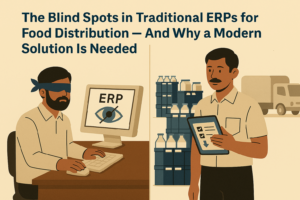
ERP systems record transactions after they happen. Food distribution needs systems that guide decisions as they happen.
This is why many distributors are choosing modern supply chain software for food industry operations—tools built specifically for inventory movement, vendor coordination, warehouse management, and order execution.
Platforms like FoodBridge are designed for how food distribution actually works in India. FoodBridge is not an ERP. It is a digital supply chain platform that gives distributors real-time visibility across inventory, procurement, suppliers, warehouses, and orders.
It answers real questions distributors ask every day:
- How to track stock in warehouse
- How to manage warehouse stock for distributors
- How to reduce spoilage in food supply chain
- How food distributors track orders
- How to manage supplier performance
Moving Forward With Confidence
Food distribution will always be demanding. But confusion, loss, and stress don’t have to be part of the job.
In Punjab, Haryana, and across India, distributors who adopt supply chain automation for distributors are finding something powerful—not just efficiency, but peace of mind.
Inventory becomes visible. Teams become aligned. Loss reduces. Trust returns.
Technology does not replace experience. It supports it.
And in a business built on timing, freshness, and trust, that support makes all the difference.

3 Responses