
The Morning Everything Changes
At 5:40 in the morning, before the city is fully awake, food distribution is already in motion. Warehouse lights are on. Trucks are being loaded. Phones are ringing. Someone is checking stock against orders that need to leave before sunrise.
And sometimes, that’s when the problem reveals itself.
The system says there are two hundred crates in cold storage. The warehouse floor says there are one hundred and thirty-seven. Somewhere between dispatch, manual entry, and delayed updates, visibility disappeared. By the time the discrepancy is discovered, delivery commitments have already been made. Customers are expecting stock. Drivers are waiting. And suddenly, a simple number becomes a chain reaction of stress, blame, and financial loss.
This is not an isolated incident. It is the everyday reality of food distribution in 2026.
The Illusion of Control in Modern Food Distribution
Margins are tighter than ever. Logistics costs fluctuate unpredictably. Customers demand faster deliveries and higher quality standards. Seasonal swings are sharper. Harvest cycles shift. Cold-chain requirements grow stricter. And yet, many distributors still rely on yesterday’s data to make today’s decisions.
When Delayed Information Becomes Expensive
In food distribution, delayed information is more dangerous than no information. Because food is perishable. It expires. It spoils. It reacts to temperature. It reacts to time. A small delay in knowing what is actually happening inside a warehouse can quietly erode profitability.
Real-time supply chain visibility is often described in technical terms, but for distributors, it is deeply human. It is the difference between confidence and uncertainty. It is the warehouse manager who can trust the numbers on the screen. It is the sales representative who knows what can be promised without calling three different people for confirmation. It is the procurement head who can see supplier reliability patterns before a delivery fails.
Without visibility, decisions become assumptions. And assumptions are expensive.
Why Traditional ERP Systems Don’t Solve Operational Chaos
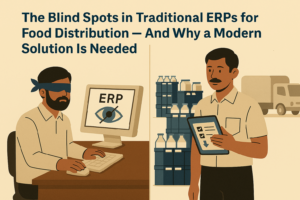
Many businesses attempt to solve this complexity with ERP systems. ERP platforms are powerful for accounting, compliance, and reporting. They record transactions well. They organize financial data. But they are rarely designed for the ground-level realities of food distribution. They do not live on the warehouse floor. They do not monitor expiry at a batch level in real time. They do not resolve coordination gaps between sales, procurement, and dispatch the moment they appear.
Food distribution does not suffer from a lack of reports. It suffers from a lack of live clarity.
Consider a distributor managing dairy across Punjab. Milk arrives daily. Cold storage must be precise. Retail deliveries cannot wait. If a batch nears expiry and no one notices in time, the loss is immediate. If stock data is inaccurate, retailers lose trust. If supplier delays are discovered too late, shelves remain empty.
What Real-Time Supply Chain Visibility Actually Looks Like
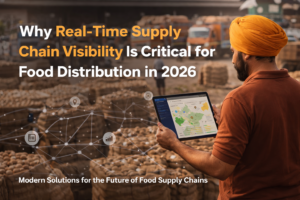
Now imagine that same distributor operating with real-time supply chain visibility. Every batch is tracked. Expiry timelines are visible. Warehouse movement updates instantly. Sales teams see live availability. Procurement teams see supplier performance history before placing the next order. Decisions shift from reactive to proactive.
The difference is not technological sophistication. It is operational clarity.
The Growing Complexity of Food Distribution in 2026
As 2026 unfolds, food distribution is no longer simply about moving goods from point A to point B. It is about managing freshness, margins, timing, and relationships simultaneously. It is about anticipating demand spikes during festivals. It is about planning procurement during harvest season. It is about ensuring cold-chain integrity under rising regulatory pressure.
Distributors who rely on spreadsheets, phone calls, and disconnected tools will increasingly feel the strain. Not because they lack experience, but because complexity has outgrown manual coordination.
From Reaction to Control: The Role of Modern Food Supply Chain Software
This is where purpose-built food supply chain software changes the equation. Not by replacing people, but by supporting them. Not by adding complexity, but by removing blind spots. A modern supply chain platform connects inventory, vendors, warehouses, and orders into a single operational view. It creates one source of truth instead of five partial ones.
FoodBridge was built with this exact challenge in mind. It is not an accounting system. It is not a generic enterprise tool trying to serve every industry. It is a supply chain platform designed specifically for food distributors who need to see what is happening right now. It focuses on inventory visibility, vendor coordination, warehouse control, and operational alignment — the areas where most losses quietly originate.
The Quiet Competitive Advantage
Back to 5:40 in the morning. The phone rings again. But this time, the distributor already knows the answer before picking up. The stock levels were visible in real time. The shortage was identified early. Inventory was reallocated before panic set in. The customer receives their delivery. The margin is protected. Trust remains intact.
The Future Belongs to Distributors Who Can See Clearly
In food distribution, the real competition is not another distributor. It is uncertainty.
And in 2026, uncertainty can no longer be managed with delayed data. It can only be managed with clarity.Real-time supply chain visibility is not a feature. It is the foundation on which modern food distribution will survive and grow.