
Food distribution has never been an easy business in India. It sits between farms, factories, warehouses, transporters, retailers, and millions of daily consumers. Every day, distributors make decisions that directly affect freshness, availability, and trust. In 2026, the biggest challenge is no longer just moving food from one place to another—it is managing the entire operation with clarity and control.
As food businesses grow, spreadsheets, manual registers, and disconnected tools stop working. What distributors now need is a supply chain management solution that reflects real ground reality, not delayed summaries. This is why real-time supply chain visibility has become essential for survival, not just growth.
The Growing Gap Between Speed and Visibility
Food moves fast, but information often does not. Orders are placed early in the morning, stock moves continuously through warehouses, and deliveries go out across cities. Yet many distributors still depend on end-of-day updates or manual stock checks to understand what happened.
This gap creates serious supply chain challenges in food distribution. Sales teams commit inventory that does not exist. Procurement teams reorder products already overstocked. Warehouse teams discover mismatches too late. These are not people problems—they are system problems caused by lack of visibility.
A modern food supply chain software closes this gap by capturing every movement as it happens.
What Supply Chain Visibility Means in Real Operations
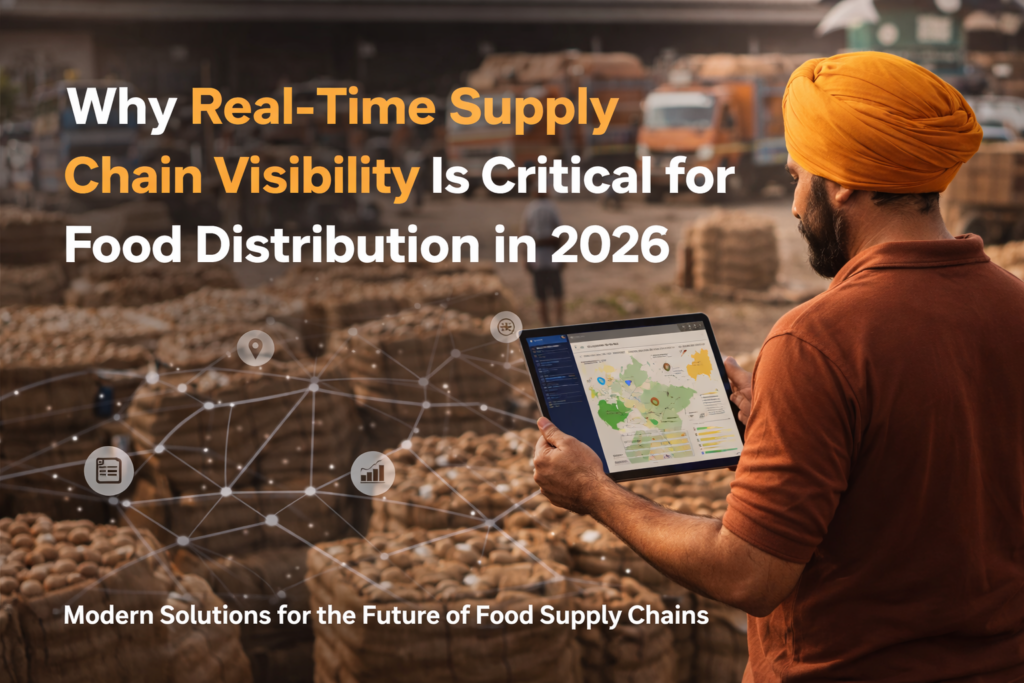
Supply chain visibility means having a clear, live view of inventory, orders, suppliers, warehouses, and logistics across the business. It answers practical questions distributors face daily: how much stock is available right now, which batches are nearing expiry, which supplier is delaying delivery, and which orders are at risk.
In food distribution, visibility must include batch tracking, expiry monitoring, and storage conditions. Without this, even well-planned inventory and distribution solutions fail to prevent loss.
A supply chain visibility platform connects procurement, warehouse inventory management software, food order management software, and food logistics management software into one continuous flow.
Where Inventory Loss Actually Begins
Most distributors lose stock not because of theft or poor sales, but because of poor tracking. Inventory mismatch is one of the most common supply chain problems in the food industry. Stock looks fine on reports but tells a different story on the warehouse floor.
Expiry tracking is another blind spot. Without proper inventory management software for food business, near-expiry stock remains unnoticed until it becomes unsellable. Cold chain distribution challenges add another layer of risk, especially for dairy and frozen goods.
This is why warehouse management software and stock management software for distributors play such an important role in daily operations.
Why Traditional ERP Systems Fall Short
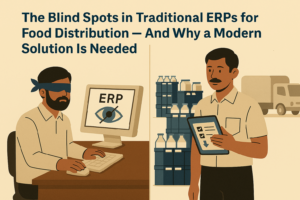
Traditional ERP systems are built mainly for accounting, compliance, and record-keeping. They work well for GST filing and financial reporting, but they struggle with live food distribution workflows.
ERPs are not designed for FEFO-based movement, batch-level visibility, or fast order execution. They often lack proper vendor management software for food distributors, making it difficult to track supplier reliability or performance.
As a result, distributors maintain multiple tools—ERP for billing, spreadsheets for inventory, and messaging apps for coordination. This fragmentation creates delays, errors, and operational stress.
The Indian Food Distribution Reality
India’s food distribution business runs on timing, relationships, and credit. Procurement depends on harvest cycles. Demand changes with festivals and seasons. Credit sales directly affect cash flow, while GST compliance adds another layer of responsibility.
In regions like Punjab and Haryana, where agricultural output feeds a large part of the country, distributors must plan carefully. Weak procurement planning for food business leads to overstocking or missed buying opportunities. Without supplier management software for distributors, evaluating vendor performance becomes guesswork.
A digital supply chain platform built for Indian food businesses understands these realities.
How Real-Time Visibility Improves Daily Decision-Making
With real-time visibility, distributors finally gain control over how food distributors manage inventory at scale. Procurement teams base decisions on live movement and demand trends. Sales teams commit orders with confidence. Warehouse teams follow FIFO and FEFO processes naturally.
This also improves how food distributors track orders. Orders move smoothly from booking to dispatch to delivery. Delays are visible early, making coordination between sales and warehouse teams easier and more effective.
All of this becomes possible with supply chain automation software that reduces manual effort and human error.
Preventing Spoilage Instead of Reacting to It
Spoilage is one of the biggest hidden costs in food distribution. Most spoilage happens because problems are noticed too late. Real-time systems allow distributors to identify near-expiry stock early, take corrective action, and reduce loss.
Automated alerts, batch tracking, and expiry monitoring help distributors follow FIFO inventory method and FEFO inventory method explained in real workflows, not just theory. This is the most effective way to reduce spoilage in food supply chain operations.
Vendor, Procurement, and Performance Control
Food distribution depends heavily on suppliers. Without a structured vendor management solution, distributors struggle to measure delivery timelines, quality consistency, and reliability.
Vendor management software enables supplier reliability tracking methods that support better procurement planning and supplier accountability. This improves harvest season procurement planning and reduces dependency risks.
Why Modern Supply Chain Software Is the Way Forward
This is where FoodBridge makes a meaningful difference. FoodBridge is not a traditional or modern ERP. It is a supply chain software for food industry built specifically to manage inventory, procurement, distribution, and vendor coordination in real time.
FoodBridge works as a complete distribution management software for food business, bringing together warehouse inventory management, food order management, supplier management, and logistics visibility into one connected system.
It helps distributors manage food inventory, track warehouse stock accurately, plan procurement confidently, manage supplier performance, and coordinate operations across teams and locations.
Preparing for Food Distribution in 2026
The future of food distribution is digital, automated, and visibility-driven. Distributors who rely on manual processes will continue to face inventory mismatches, spoilage, and coordination issues. Those who adopt supply chain automation for distributors will operate with greater confidence and resilience.
By 2026, end-to-end supply chain visibility will no longer be optional. It will be the foundation of sustainable food distribution.
Food distribution is ultimately about timing, trust, and transparency. Real-time visibility is what makes all three possible.